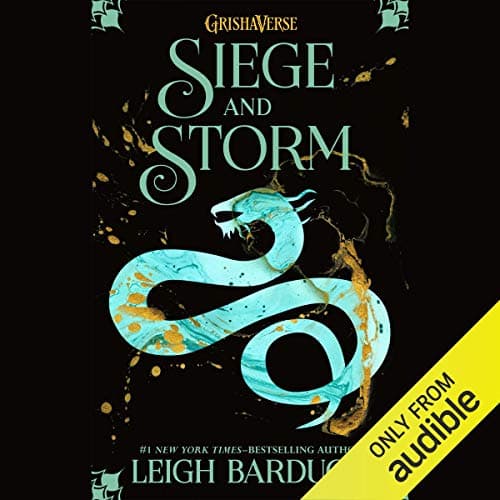
Everyone keeps telling me this is a YA fantasy, and sure, technically, yes. But I was shelving returns at the library last Tuesday — quiet afternoon, maybe three patrons in the whole building — listening through one earbud, and there's this sequence where Alina is being paraded through court politics so thick with manipulation that I actually stopped mid-shelf and thought, "This is a horror of identity." Not horror in my usual sense. No ghosts, no creeping dread. But the slow erosion of who someone is? The way the Darkling doesn't just threaten Alina's body but her sense of self? That's the stuff that keeps me up at night more than any jump scare.
So yeah. I came into Siege and Storm expecting a bridge book — the dreaded second installment that exists mostly to shuttle characters from setup to climax. And in some ways, it is that. But Bardugo does something sneaky here that earns my respect.
The Darkling Problem (Which Is Actually the Point)
Here's what I didn't expect to care about: the politics. The first book, Shadow and Bone, was survival and discovery. This one drops Alina into a nest of Ravkan court intrigue where every alliance is conditional and every smile hides a knife. The introduction of Sturmhond — privateer, schemer, the kind of character who walks into a room and immediately owns it — shifts the entire energy. He's not just comic relief or a love triangle addition (though the book flirts with that). He represents a third option: power through cleverness rather than magic or brute force. That particular dynamic — the clever mortal carving out space among the magically gifted — is something I kept thinking about in relation to Excalibur, where the tension between human ambition and something larger and stranger than human does genuinely haunting work. That push-and-pull between Alina's growing Grisha power and Sturmhond's mortal resourcefulness kept me engaged through stretches that, honestly, could've used tighter pacing.
Because yes — it does slow down. Particularly in the middle third, when Alina is at the Little Palace again and court life settles into a rhythm of training, political maneuvering, and Mal being... Mal. I love a brooding love interest as much as the next person, but Mal's resentment arc in this book tested me. His jealousy reads less like complex characterization and more like a guy who can't handle his girlfriend being more powerful than him. Bardugo seems aware of this — she uses it to isolate Alina further — but awareness doesn't always equal satisfaction.
Lauren Fortgang Earned Her Sea Legs
Okay, let's talk narration. I listened to Shadow and Bone last year and thought Fortgang was solid but sometimes a little too even-keeled for the material. Here? She's leveled up. Her Darkling voice has this measured, almost tender quality that makes his manipulation land harder — he doesn't sound villainous, he sounds reasonable, which is so much worse. And Sturmhond gets this irreverent lilt, almost playful, that immediately distinguishes him from Mal's more earnest, grounded tone.
The narrator commits. That's rare.
Where Fortgang really surprised me was in the quieter emotional beats. There's a stretch after Alina uses the second amplifier where her voice takes on this brittle, hollow quality — like Alina is performing confidence while something inside her is cracking. It's not showy. It's the kind of choice that makes you realize you're listening to someone who actually read the whole book before recording, who understands where this character is headed.
Is it perfect? No. Some of the action sequences blur together sonically — sword fights and Grisha power clashes don't always differentiate well in a single-narrator format, and there were moments I had to rewind to figure out who was doing what to whom. But that's a limitation of the format, not really Fortgang's fault.
Forbidden Magic as Addiction Metaphor (Bardugo Isn't Subtle, and That's Fine)
What kept me thinking about this book after it ended — and what I'll probably talk about on the podcast — is how Bardugo handles Alina's relationship with power. The amplifiers aren't just plot devices. They're addiction. Each one gives Alina more strength but costs her something she can't name. The Darkling keeps offering her shortcuts, and the horror isn't that she might say yes — it's that saying yes feels correct. Logical. Earned.
Shirley Jackson walked so Bardugo could explore the haunted house that lives inside ambition. (Okay, that's a stretch, but my podcast listeners are going to love the comparison, so I'm keeping it.)
The book's real darkness isn't the Shadow Fold or the volcra. It's the moment Alina realizes she enjoys the power more than she wants to admit, and that the people who love her can see it before she can.
Who Should Listen (And Who Should Skip)
If you liked the world of Shadow and Bone but wanted more political complexity and a protagonist wrestling with genuine moral ambiguity, this delivers. If you need constant action or find court intrigue tedious, you'll hit a wall around the middle. And if Mal's particular brand of romantic insecurity makes you want to throw your phone — skip it, or at least brace yourself.
At nearly twelve hours, it asks for real time. It rewards focused listening. I wouldn't call it background material — Bardugo's political maneuvering requires attention, and Fortgang's vocal choices are too good to half-hear.
Shirley (my cat) was unimpressed. I was genuinely invested. And I don't say that about every YA fantasy sequel that's secretly a story about how power corrupts the people who think they're too good to be corrupted.