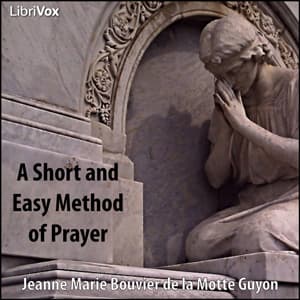

What do you do with a woman who was thrown into prison for seven years because she dared to suggest that ordinary people could talk to God without a priest holding their hand?
You listen to her. That's what you do.
I came to Madame Guyon's Short and Easy Method of Prayer sideways - not through any spiritual crisis, but because I'd been rereading Simone Weil's Waiting for God and someone on my podcast's tiny Discord (yes, all 47 of us have a Discord) mentioned Guyon as a predecessor. So I queued it up during one of those Sunday mornings where Denise was at her sister's and I had the apartment to myself, coffee going, lake light coming through the windows. And I'll be honest: I expected something dusty. Something that felt like homework.
It didn't.
A 17th-Century Woman Who Got Arrested for Being Too Direct
Here's what strikes me about Guyon, and what I think most people miss when they treat this as just another devotional text: this book got her locked up. Published in 1685, it was considered dangerous - not because it was heretical in any obvious way, but because it democratized something the institutional church wanted to keep gatekept. Guyon's argument is almost embarrassingly simple: stop trying so hard. Stop performing prayer. Just... be present. She calls it her "unmethodical method," which is the kind of beautiful contradiction my AP Lit students would circle and annotate.
The book reads like someone who has genuinely experienced what she's describing and is frustrated that everyone keeps overcomplicating it. There's an urgency underneath her measured 17th-century prose. She's not writing a theological treatise - she's writing instructions. Do this. Then stop doing that. No, really, stop. If you loved the radical simplicity of Brother Lawrence's The Practice of the Presence of God, this is its spiritual successor - or maybe its predecessor, since Guyon was working in the same French mystical tradition just a few decades later.
Jordan and the Question of Quiet
Now, the narration. Jordan reads this in a single, measured voice - no dramatics, no vocal fireworks. And here's where I'm genuinely torn, because for most audiobooks I'd say a narrator needs to interpret, not just read. The narrator understands that pause is punctuation - that's my usual standard. But Jordan's approach is... flat might be unfair. Let's say even. Consistent. Almost meditative in its steadiness.
And I kept going back and forth on whether that's a problem or whether it accidentally serves the material. Guyon is literally arguing for interior stillness. She's telling you to quiet down. So a narrator who doesn't inject personality into every sentence - is that a failure of performance or an act of restraint? I genuinely don't know. What I do know is that by chapter eight or nine, Jordan's voice had become something like background music to my own thinking, which felt appropriate for a book about contemplative prayer, but might drive you nuts if you're looking for an engaging performance.
At under two hours, the commitment is minimal. This is the length of a long podcast episode. (My Faulkner episodes run longer, and I can confirm nobody finishes those either.)
The Prose Deserves Its Own Moment
What surprised me most was Guyon's clarity. I teach kids who think anything written before 1950 is incomprehensible, and I keep a mental list of counterexamples to throw at them. Guyon goes on that list. Her sentences are clean. Her arguments build logically even when she's describing something inherently illogical - the experience of divine presence, the paradox of effortful effortlessness. She writes about the soul the way a good nature writer describes landscape: with patience and specific attention.
The influence chain is real, too. You can draw a straight line from Guyon through the Quietist movement to John Wesley's emphasis on personal experience of God, through to the contemplative prayer traditions that Thomas Merton picked up centuries later. If you're interested in how Christian mysticism actually developed - not just the greatest hits version - Guyon is essential context.
My students would hate this. I love it. Not because it's difficult, but because it's the opposite: it's so simple it makes you uncomfortable. Guyon keeps stripping away the things you hide behind - your techniques, your formulas, your busy-ness disguised as devotion - until you're left with just... you. Sitting there. Being quiet. I noticed a similar stripping-away impulse in Own Your Everyday, though it comes at the problem from a much more modern, productivity-adjacent angle - less mystical prison sentence, more motivational podcast, but the underlying argument about dropping the performance is surprisingly close.
Worth the Sunday Morning
This isn't for everyone. If you want narrative, character, plot - wrong book, wrong shelf. If you're hostile to religious content, nothing here will convert you. But if you're curious about the mystic tradition, if you've ever wondered why contemplative prayer keeps coming back into fashion every few decades, or if you just want to spend two hours with a woman brave enough to go to prison for saying "prayer isn't that complicated" - queue it up. The prose deserves to be savored, even in this modest audio presentation. And at two hours, the only thing you're risking is a quiet Sunday.