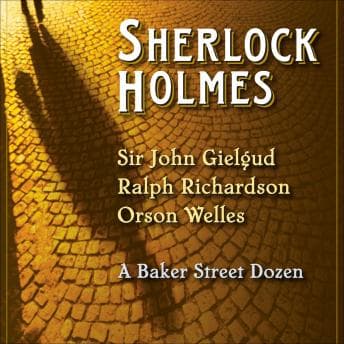

What makes a definitive Holmes?
I was chopping onions for a biryani I'd never finish alone (story of my life) when Gielgud's voice cut through my kitchen like the man himself had materialized to deduce my poor knife technique. And I found myself genuinely asking: after a century of adaptations, after Cumberbatch and Downey Jr. and countless others, why does this 1950s radio production still feel so... right?
The research actually shows something fascinating about character psychology here. Most modern Holmes adaptations lean into his alienness—the sociopath genius who can't connect with ordinary humans. But Gielgud plays him with what I can only describe as a "light touch." There's warmth underneath the brilliance. He's not performing superiority; he's simply operating on a different wavelength while genuinely enjoying Watson's company. It's a subtle distinction that changes everything about how we read Holmes's motivations.
Watson Finally Gets His Due
Ralph Richardson's Watson might be the revelation here. The research describes him as having a "foxy, intelligent air"—and that's exactly it. This isn't the bumbling sidekick we've been conditioned to expect. Richardson plays Watson as a capable man who happens to be standing next to a genius. The chemistry between them feels like genuine fondness between equals, not tolerance of a lesser intellect.
Psychologically, this tracks with Doyle's original intent far better than most adaptations. Watson was a military doctor, a man of action and intelligence. The "idiot Watson" trope is a later invention. Richardson seems to understand this instinctively.
The twelve stories here—from "A Scandal in Bohemia" to "The Speckled Band"—each run about 20-25 minutes in radio drama format. Yes, content gets pared down. Some listeners complain you need to follow along with the text. But honestly? The compression forces focus on what matters: the psychological puzzle, the deductive revelation, the interplay between two brilliant men.
The Moriarty Problem (Solved)
Orson Welles shows up as Moriarty in "The Final Problem" and—look, I'm not going to pretend I'm objective about this. Three theatrical giants in one production is almost unfair. Welles brings exactly the gravitas that Holmes's nemesis requires. When these two titans face off, you understand why Doyle considered this the end of the story. The stakes feel genuinely mortal. That same theatrical intensity—where you can practically feel the danger crackling through the performance—reminded me of Eruption, though obviously in a completely different genre.
The full dramatization with sound effects and music creates atmosphere that a single narrator simply can't match. Though I should warn you: those violin interludes between stories? They're period-appropriate and charming on speakers. On headphones during a jog, they become... less charming. I switched to speakers-only after the third story.
The Compression Trade-Off
Here's where I have to be honest about limitations. At 5 hours 20 minutes for twelve stories, you're getting radio drama efficiency, not novelistic depth. If you want every detail of "The Speckled Band's" setting or the full psychological unraveling in "Charles Augustus Milverton," you'll need the unabridged versions.
But what you lose in detail, you gain in theatrical immediacy. The crisp dialogue. The emotional beats landing precisely where they should. The period atmosphere that somehow feels more authentic than many modern "faithful" adaptations.
My therapist would have thoughts about why I find these tidy 25-minute mysteries so satisfying. Something about the comfort of problems that can be solved through observation and logic. (The real world is messier. My research subjects don't come with clues conveniently scattered around their crime scenes.)
Who Should Deduce Their Way Here
This is for you if: you love Holmes and want to hear him played by actors who actually understand the character's psychology. If you appreciate radio drama as an art form. If you want something to accompany focused activities—cooking, cleaning, a quiet evening.
Skip it if: you need every detail from the original stories. If you listen primarily on headphones and hate musical interludes. If you want action-packed modern pacing.
Case Closed, Biryani Burned
Gielgud and Richardson recorded these in an era when radio drama was serious business, and it shows. The production values, the casting, the adaptation choices—they all serve the essential mystery: understanding why people do what they do. Which, at the end of the day, is what both psychology and detective fiction are really about.
My onions burned, by the way. Worth it.