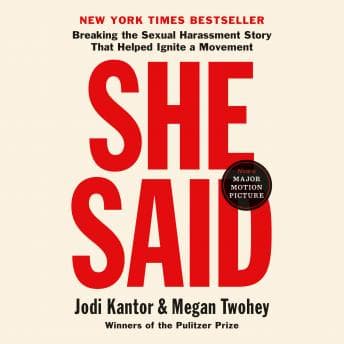

This book made me angry in a way that felt physical.
I was at my desk at 2 AM, finishing a logo rebrand I'd been putting off for weeks, and I had She Said playing because I figured investigative journalism would keep me sharp and focused. Instead I found myself stopped mid-kerning adjustment, just sitting there with my hands hovering over the keyboard, jaw clenched, heart hammering. Diego was asleep on my lap and I was white-knuckling the edge of my desk like it owed me money.
The Weight of Women Deciding to Speak
Here's what separates She Said from every other #MeToo-adjacent book or podcast or documentary I've consumed: Kantor and Twohey don't just tell you what Weinstein did. They make you sit inside the excruciating process of women deciding — after years, sometimes decades — whether to attach their names to the truth. The gathering at Gwyneth Paltrow's house, where these women who'd carried this weight for so long finally sat together in the same room? That scene wrecked me. Not because of some dramatic confrontation, but because of the quiet recognition between them. The unspoken you too? that doesn't need words.
And then there's the other side — the phone calls where sources go quiet, where a woman who was ready to talk suddenly isn't, because Weinstein's private investigators showed up in her life like ghosts. The book makes you feel the fragility of the whole investigation. How close it came to collapsing. How many times these reporters hit walls made of NDAs and legal threats and pure, calculated fear.
I ugly-cried during the final confrontation between Weinstein and the Times. Not dramatic sobs — more like this hot, frustrated crying where you're angry and relieved at the same time, because you know the story gets published but the book makes you feel how uncertain that outcome was for the people living it.
Three Narrators, Two Journalists, One Gut Punch
So here's what's interesting about the audio production: Kantor and Twohey narrate parts of the book themselves, and Rebecca Lowman handles the bulk of the storytelling. And honestly? The contrast works in a way I didn't expect. When Kantor or Twohey step in to narrate their own sections, there's this rawness — one of them has a slight vocal fry that creeps in at the end of sentences when the material gets heavy, and instead of being distracting, it sounds like someone who's still processing what they uncovered. It's not polished narrator voice. It's journalist voice. There's a difference.
Lowman, though — she's the backbone. Her delivery has this clarity that keeps you locked in during the procedural stretches, the parts about legal frameworks and corporate cover-up mechanics that could easily lose you. She doesn't dramatize. She doesn't need to. The material is already burning.
Compared to, say, Ronan Farrow's Catch and Kill (which I also listened to and which covers overlapping territory), She Said feels less like a thriller and more like a slow, precise excavation. Farrow's book is cinematic — spies, wiretaps, Hollywood drama. Kantor and Twohey's book is about the unglamorous, painstaking, emotionally brutal work of getting women to trust you enough to speak. It's quieter. And for me, it hit harder. That same quality of quiet precision making something land harder than you expect — I got a version of that reading Lincoln Highway, which is wildly different in subject matter but shares that unhurried confidence in its own storytelling.
Who This Is For (and Who Should Brace Themselves)
If you want to understand not just what happened with Weinstein but how investigative journalism works when the stakes are someone's entire life and career — listen to this. If you've ever wondered why women don't come forward, this book answers that question with such devastating specificity that you'll never ask it again.
But fair warning: the content is exactly what you'd expect. Sexual harassment, abuse, institutional cover-ups. It's handled with care but it's not softened. I had to pause a few times. Not because the writing was graphic — it's actually restrained — but because the accumulation of it, story after story after story, just sits on your chest.
Abuela would have listened to this and gone very quiet, which was her version of fury. She had no patience for men who used power like a weapon. She would've loved these two reporters.
My Heart Is Still Clenched
At 9 hours and 53 minutes, this is a book that earns every minute. I listened at my usual 1.0x because rushing through these women's stories felt wrong. By the end I was still sitting at my desk, logo forgotten, Diego relocated to the couch, and I just... sat there. Some books make you cry because they're beautiful. This one made me cry because it's true. That's a different kind of devastation.