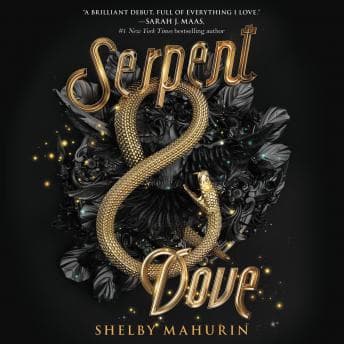

Look, I need to complain about something first. The magic system in this book? It's there, it's interesting, it's got this whole give-and-take balance thing going on - and then Mahurin just... doesn't explain it thoroughly enough. I spent like three chapters trying to figure out the exact rules of how Lou's magic works, and honestly, I'm still a little fuzzy. My D&D group would have questions. Many questions.
But here's the thing - I kept listening anyway. For fourteen hours. Instead of working on my thesis. (Dr. Patel, if you're reading this, I was doing "research on narrative structure.")
The Enemies-to-Lovers Slow Burn That Actually Works
Okay, so the premise is basically: witch who's hiding from her coven + witch hunter who's been raised to literally burn witches = forced marriage. It's not subtle. It's not trying to be. And you know what? The progression is satisfying. Lou and Reid's dynamic starts with genuine hostility - not that fake "we hate each other but secretly we're attracted" thing that makes me roll my eyes. Reid genuinely believes witches are evil. Lou genuinely thinks he's an uptight zealot. They're both right and wrong in ways that matter.
The dual narration helps a lot here. Holter Graham handles Reid's chapters, and Saskia Maarleveld takes Lou's. Graham's got this earnest, almost too-serious delivery that fits Reid perfectly - the guy's basically a fantasy paladin who's never questioned his oath. Maarleveld gives Lou this edge of dark humor and defiance that makes her immediately likeable. When they're doing scenes together (you know what I mean - the same scene from different POVs), you can actually feel the tension in how differently they interpret the same moments.
Where the World-Building Gets Fuzzy
So Cesarine is basically fantasy France with witch trials. The Church hunts witches, there's this whole inquisition vibe, and Lou's living in the city disguised as a regular human. Cool setup. I'm into it.
But - and this is where my Sanderson-trained brain started twitching - the magic system feels soft when I wanted it to be hard. Lou's witchcraft operates on this principle of equivalent exchange (give something to get something), which is great in theory. The problem is the "something" is vague. Sometimes it's a memory. Sometimes it's a physical sensation. Sometimes it's... vibes? Revelations had a similar issue with its magic feeling more atmospheric than systematic. I couldn't tell if this was intentional mystery or just underdeveloped.
The world itself has the same issue. We get hints of a bigger political situation, other covens, the history between witches and the Church - but it's all sketched rather than painted. This is book one of a trilogy, so maybe that's intentional setup, but I wanted more. Give me the lore dump. I can handle it.
Graham and Maarleveld Carried Some Weak Spots
There are definitely sections in the middle where the plot drags. Lou's hiding her identity, Reid's being oblivious, they're circling each other - we get it. Some of these scenes felt like they could've been cut without losing anything. But Maarleveld's delivery kept me engaged even when the pacing slowed down. She's got this way of making Lou's internal snark land perfectly.
Graham's Reid is interesting because he makes the character sympathetic even when Reid's being frustratingly rigid. You can hear the genuine belief in his voice, the way he's been indoctrinated since childhood. It's not a villain performance - it's someone who thinks they're the hero and is slowly realizing their whole worldview might be wrong. That's harder to pull off than it sounds.
The production quality is solid. Clean audio, no weird transitions between narrators, good pacing on chapter breaks. Nothing flashy, but nothing distracting either.
Roll for Romance, Not for Lore
If you're looking for a romance with fantasy elements rather than a fantasy with romance elements, this is your book. The central relationship drives everything. The magic and world-building are there to create obstacles and stakes for Lou and Reid, not the other way around.
Fans of Sarah J. Maas will probably dig this - there's a similar vibe of "powerful woman hiding her true nature from the man who'd destroy her if he knew." It's not as epic in scope as something like A Court of Thorns and Roses, but it's also tighter and more focused.
If you're like me and you want your fantasy magic systems explained with the precision of a physics textbook, you might get frustrated. Skip this one if soft magic makes you twitch. But if you can let that go and just enjoy the character dynamics, there's a lot to like here.
I'm probably going to listen to book two. Not because I need to know what happens with the magic (though I do want answers), but because I genuinely want to see where Lou and Reid end up. And honestly? That's what this book is trying to do, and it succeeds.
My thesis can wait another fourteen hours.