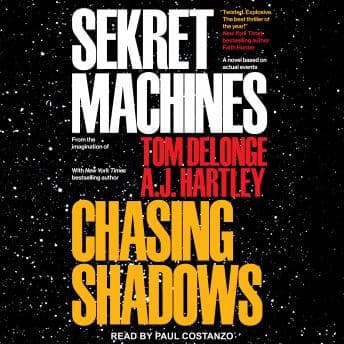

Look, I need to address something right off the bat: yes, the Blink-182 guy wrote a UFO novel. And somehow? It's actually... good? I went into this expecting a vanity project with some alien vibes slapped on, and instead I got 17 hours of genuinely compelling sci-fi conspiracy thriller that had me pausing my thesis work (okay, pausing my thesis procrastination) to actually pay attention.
The premise hooks you immediately - we're following four different characters across different time periods, all connected by UFO encounters. A pilot, an heiress, a journalist, a POW. The way A.J. Hartley and Tom DeLonge weave these threads together is giving me serious Sanderson vibes in terms of structure. Not the magic systems, obviously, but that same satisfaction of watching puzzle pieces click into place across multiple POVs.
When the World-Building Actually Delivers
Here's what surprised me most: the research. DeLonge apparently has actual sources in the military and intelligence community (the guy won UFO Researcher of the Year in 2017, which is apparently a thing), and you can feel it. The book blends real events with fiction in a way that had me Googling stuff at 2 AM instead of, you know, working on my thesis. Mysterious Island does something similar with that blend of real science and speculative fiction, though Verne's version is way less paranoid about government conspiracies. The Nevada sequences especially - there's this attention to procedural detail that makes the fantastical stuff land harder when it hits.
The alternating perspectives keep things moving. Just when you're settling into one storyline, we jump to another, and normally that drives me crazy but here it works. Each POV brings a different angle on the same phenomenon. It's like running a campaign where each player sees different parts of the conspiracy. (My D&D group would absolutely love this as campaign inspiration, honestly.)
The Voice in My Ears for 17 Hours
Paul Costanzo. I didn't know him before this, but the guy's got range. His character voices are distinct enough that I never lost track of who was speaking, even when I was half-focused on debugging code. The pacing is solid - he knows when to let tension build and when to punch through a revelation.
But I gotta be honest about something. Some listeners have mentioned his "S" sounds being a bit whispy, and once I noticed it, I couldn't un-notice it. It's not a dealbreaker - not even close - but if you're someone who fixates on audio quirks, maybe sample first. His accent attempts are... enthusiastic? The New England accent got a chuckle out of me, but not in a way that broke immersion. More like a DM doing his best Boston impression at the table. You appreciate the effort.
The production itself is clean. No weird audio glitches, no jarring transitions. Professional stuff.
Where It Drags (Because Nothing's Perfect)
Okay, so 17 hours and 45 minutes is a commitment. And there are stretches - particularly in the middle - where the pacing dips. Some of the exposition-heavy sections feel more like briefing documents than narrative. If you're not already bought into the conspiracy thriller vibe, these moments might lose you.
Also, this isn't a funny book. Like, at all. It takes itself seriously, which works for the tone they're going for, but if you need wit and banter in your sci-fi, look elsewhere. This is the X-Files, not Hitchhiker's Guide.
Who Should Listen (And Who Should Skip)
If you're into conspiracy thrillers, multi-POV narratives, or you've ever fallen down a UFO rabbit hole at 2 AM, this one's for you. Skip it if you need humor in your sci-fi or can't handle 17+ hours of serious, slow-burn tension.
The Thesis-Avoiding Verdict
I listened to this during a week of "productive procrastination" (coding side projects, avoiding Dr. Patel's emails about my chapter drafts), and it was perfect for that headspace. Engaging enough to keep me hooked, substantial enough to feel like I was doing something with my time. The multi-perspective structure means there's always something happening, even when individual threads slow down.
Is it Sanderson-level world-building? No. But it's scratching a similar itch - that satisfaction of a larger picture emerging from fragments. Plus there's something genuinely unsettling about how much of this could be real. DeLonge's whole deal with To The Stars Academy and his Pentagon connections adds this meta layer where you're reading fiction that might be... less fictional than you'd like?
For commutes, long drives, or extended thesis avoidance sessions, this is solid. Just maybe bump the speed to 1.25x during the slower expository sections. And if the whispy S's bother you, sample the audio first. Otherwise? Yeah. The Blink-182 guy wrote a good UFO book. 2024 is weird.