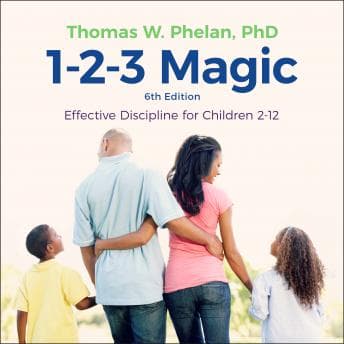

Seven hours. Seven hours of being told to count to three.
Look, I get it. I've sat through McKinsey presentations that could've been emails. I've endured two-day offsites that delivered one decent insight. But listening to Dr. Phelan explain the concept of counting 1-2-3 for seven hours while stuck in LAX waiting for a delayed flight to Denver? That's a special kind of purgatory.
Here's the thing though—and I'm genuinely annoyed to admit this—the core methodology actually works. I've recommended variations of this to three different startup founders dealing with their kids' behavior spiraling during the chaos of Series A. All three came back saying it helped. So now I have to give this book a fair shake even though my brain kept screaming "I UNDERSTAND THE CONCEPT, MOVE ON."
What My Parents Already Knew (But Without the PhD)
The fundamental premise is elegant in its simplicity: Stop Behavior (counting 1-2-3 with consequences) and Start Behavior (different tactics for things like homework and chores). That's it. That's the framework. My mom had her own version—she'd just give me The Look, and I'd course-correct immediately. No counting required. But I recognize not everyone grew up with a Korean mother who could communicate disappointment through a single eyebrow raise.
Dr. Phelan's contribution is systematizing this into something teachable. The "no talking, no emotion" rule during discipline is genuinely counterintuitive for most American parents who want to explain and negotiate everything. I've seen this same dynamic kill startups—founders who can't make a decision without a 45-minute discussion about everyone's feelings. The 50th Law tackles this same paralysis from a different angle—decisiveness as survival, not just efficiency. Sometimes you just need to count to three and enforce the consequence.
Paul Costanzo Keeps This From Becoming Background Noise
One reviewer called this "seven hours of an infomercial," and honestly? Fair. The book does have that repetitive, "but wait there's more" energy. Paul Costanzo's narration has this calm, measured quality that keeps it from feeling like you're being sold something, though. AudioFile wasn't wrong calling it superb—there's a sensitivity to his delivery that makes the parenting advice feel less preachy and more like a conversation with a reasonable person.
No dramatic character voices here—this is straight instructional content. Costanzo reads it clean and professional. At 1.5x speed (couldn't quite handle my usual 2.0x because some of the behavioral examples needed processing time), it became digestible. Still longer than necessary, but digestible.
The Uncomfortable Truth About Parenting Books
I don't have kids. Jenny and I are still in the "maybe someday" phase of life. But I've watched enough of my clients struggle with work-life balance while their home lives deteriorate to know that parenting frameworks matter. One founder I worked with was so conflict-averse with his kids that they were running the household by age 8. His inability to set boundaries at home bled directly into his inability to make hard calls at work. I've seen the inverse problem too—leaders who read Awaken the Giant Within and get great at personal transformation but still can't translate that into managing other humans. We eventually had a conversation about this book.
The criticism that 1-2-3 Magic focuses on punishment over teaching self-discipline isn't entirely unfair. Phelan does address building the parent-child relationship in later sections, but the emphasis is clearly on compliance first. For some families, that's exactly what's needed. For others, it might feel too transactional.
Jenny would say I'm being harsh. Jenny is right. But she'd also agree that a book promising to solve all your parenting problems in "three easy steps" deserves some skepticism.
Who Gets Value Here (And Who Doesn't)
This is for parents who are drowning. The ones who've tried reasoning with their four-year-old about why hitting is wrong and gotten nowhere. The ones who are exhausted from bedtime battles that stretch past 10 PM. If that's you, skip to chapter 3 where the actual methodology starts. Thank me later.
If you're looking for a nuanced exploration of child psychology and development? This ain't it. If you want something you can implement tonight when your kid refuses to get off the iPad? This is exactly it.
Skip if: You already have decent systems in place. You want research citations on every page. You need to feel good about your parenting philosophy rather than just getting results.
The Bottom Line, No Charge
This is a 90-minute framework stretched into a 7-hour audiobook. The ROI is there if you're in crisis mode and need something actionable immediately. The methodology is sound—I've seen it work in practice. Paul Costanzo's narration is professional and pleasant.
But the padding is real. So much padding. Examples that repeat the same concept. Scenarios that feel redundant by hour four. If Phelan had applied the same efficiency to his book that he wants parents to apply to discipline, this would be a tight two hours and I'd be giving it a higher rating.
Still—a parenting book that respects the reality that exhausted parents don't have time for theory. They need a system. This delivers one. Just at about three times the necessary length.
Speed it up, skip the repetition, implement the core concept. That's the consulting advice.