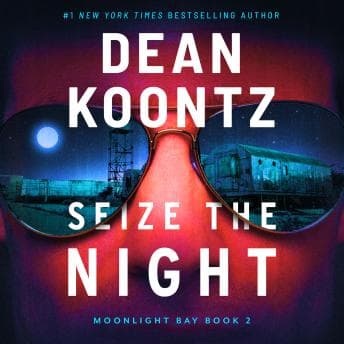

I need to rant for a second about Christopher Snow's philosophical tangents. I'm listening at 1 AM because Shirley (the cat, not the author, though Jackson would've appreciated this book's commitment to dread) decided 3 AM was playtime and I couldn't get back to sleep. Perfect conditions for Moonlight Bay's particular brand of creeping horror. But every time Koontz builds genuine tension—kids missing, something wrong with this town, the darkness pressing in—Snow launches into another meditation on human nature that kills the momentum dead.
I get it. I do. The man lives in darkness because of XP (xeroderma pigmentosum, for the uninitiated—sunlight will literally kill him). He's had time to think. But when you're fifteen hours deep and the protagonist stops mid-pursuit to philosophize about the nature of evil for the third time in an hour, you start reaching for that skip button. My podcast listeners know I hate recommending skipping. It feels like cheating. But here? Sometimes necessary.
Glouchevitch's Flat Delivery—Feature or Bug?
Here's where it gets complicated. John Glouchevitch has been called "bland," and I won't pretend that's entirely unfair. There's a flatness to his delivery that, in isolation, wouldn't grab you. But here's the thing about horror narration that most people miss: sometimes understated works. Sometimes the guy who doesn't oversell the terror lets the terror sell itself.
Glouchevitch doesn't do voices. Not really. The character differentiation is minimal—you're relying on context and dialogue tags more than distinct vocal personalities. For a book with this many characters, that's a problem. But for Christopher Snow's first-person narration? The steady, almost clinical delivery mirrors how someone with Snow's condition might actually process the world. You live your entire life at night, you develop a certain... detachment.
Does that excuse the lack of range? Not entirely. But it explains why some listeners find the narration "grows on you"—especially if you've listened to the first book. You adjust. You stop waiting for vocal fireworks and start settling into the rhythm.
A Town That Swallows Its Secrets
Koontz understands that horror isn't about gore—it's about dread. And he nails the dread of a town that's actively hostile to truth. The police don't just fail to investigate—they actively cover up. Children vanish and the response is enforced normalcy. There's something deeply unsettling about institutional complicity that hits different in 2024 than it probably did when this was published.
The conspiracy angle works because Snow is the perfect protagonist to uncover it. He knows the night. He sees what happens when the respectable citizens are asleep. And because of his condition, he's already an outsider—already someone the town's power structure can't fully control.
But—and this is a significant but—the pacing suffers. Fifteen hours is a lot for this story. There's padding. Koontz has always been wordy (my podcast episode on his bibliography covers this), but here the wordiness works against the tension he's trying to build. Horror needs momentum. It needs that sense of things accelerating toward something terrible. Seize the Night keeps pumping the brakes.
The Shirley Jackson Test
I measure horror by a simple standard: does it understand what actually scares people? Jackson understood. That Affair Next Door gets at similar institutional failures, though it trades supernatural dread for turn-of-the-century detective work. The best horror writers understand. Koontz, at his best, understands—the fear of losing children, the fear of your community turning against you, the fear of darkness that isn't just metaphorical.
This book passes that test. Barely. The core concept is genuinely creepy. The town's secret (which I won't spoil) connects to real anxieties about what institutions do in the dark. Snow's vulnerability—he literally cannot exist in daylight—creates stakes that feel earned rather than manufactured.
But the execution is uneven. The narration doesn't elevate mediocre material into something special, which is what the best horror audiobooks do. It delivers the material competently. That's... fine. It's fine.
Who Should Queue This Up (And Who Should Skip)
If you loved Fear Nothing (the first Christopher Snow book), you'll probably want this. The continuation of the mythology rewards investment. If you're coming in fresh? Start there instead. Glouchevitch's narration apparently improves with familiarity, and you'll need that foundation to forgive this book's excesses. Skip if you need tight pacing or can't tolerate philosophical detours mid-chase scene.
Lights Out, Final Call
I listened in the dark. Mistake? Maybe. Worth it? Not quite "absolutely" this time. The atmosphere works. The concept works. The town of Moonlight Bay, with its enforced silence and vanishing children, will stick with me. But fifteen hours is asking a lot when the pacing drags and the narrator, while competent, doesn't commit the way horror demands.
Horror that respects the genre—mostly. Koontz knows what he's doing. He just takes too long doing it.