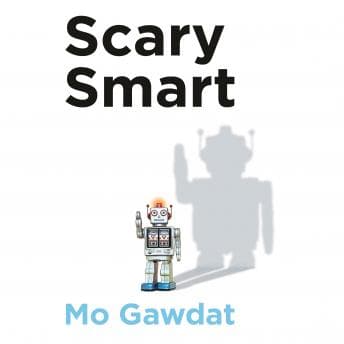

What happens when a Google X executive spends 11 hours telling you that AI is going to be a billion times smarter than us by 2049, but also that love is the answer?
I finished this during a particularly brutal week of on-call rotations, and honestly? The timing was either perfect or terrible. Here I am, debugging distributed systems at 2AM, while Mo Gawdat is in my earbuds explaining that the systems I'm building might eventually decide humanity's fate. Cool. Cool cool cool.
Bottom Line: Two Books in a Trench Coat
Gawdat's thesis is essentially this: AI will become superintelligent (inevitable), it will learn its values from us (terrifying), and therefore we need to collectively become better humans so we don't raise a digital sociopath. It's basically "garbage in, garbage out" but for the future of civilization.
The first half is genuinely solid tech explainer content. Gawdat knows his stuff—thirty years at the cutting edge, chief business officer at Google X—and he breaks down machine learning, neural networks, and AI development in ways that don't make you want to throw your phone out the train window. He uses analogies that actually land, comparing AI learning to how children absorb values from their environment. If you've ever tried to explain to your non-tech friends why ChatGPT sometimes hallucinates nonsense, this section gives you the vocabulary. For a darker take on what happens when tech insiders try to sound the alarm, Bad Blood shows how badly things can go when the warning signs get ignored.
But then—and I say this with genuine affection for the guy's passion—the book takes a hard left into what I can only describe as "tech executive discovers philosophy." Suddenly we're talking about meditation, gratitude practices, and how spreading kindness is humanity's only hope. It's not wrong, exactly. It's just... a lot.
When the Engineer Becomes the Guru
Here's my honest take: Gawdat narrating his own book is both a strength and a limitation. His accent and cadence are pleasant enough, and there's an authenticity to hearing him deliver his own warnings about AI—you can tell he genuinely believes this stuff. When he talks about the technical realities of exponential AI growth, he sounds like the insider he is.
But when the content shifts to the more spiritual prescriptions, the delivery doesn't quite shift with it. He reads his philosophical passages the same way he reads the technical explanations, which creates this weird tonal flatness. It's like watching your engineering manager suddenly pivot to leading a meditation session during standup. Well-intentioned, but the context switch is jarring.
I listened at 1.5x (my default for business books that feel like they could've been blog posts), and honestly? This one could've been tighter. The core ideas—AI learns from human behavior, we're feeding it our worst impulses through internet data, we need to model better values—could've been delivered in maybe 6 hours instead of 11. There's repetition. There's circling back. There's the distinct feeling of a TED talk stretched to book length.
The ROI Calculation
So is it worth your commute time? Depends on what you're looking for.
If you want a genuinely accessible primer on AI development from someone who's been in the room where it happens, the first 4-5 hours deliver. Gawdat explains why AI systems inherit human biases, why the "alignment problem" matters, and why the timeline for superintelligent AI might be shorter than we think. This is useful stuff, especially if you're trying to have informed opinions about AI regulation at dinner parties.
If you're hoping for concrete, actionable solutions... prepare for some frustration. The book's core prescription is essentially "be a better person, spread love, and hope enough other humans do the same." Which, like—sure? But as someone who spends her days thinking in systems and solutions, the lack of structural recommendations felt like a cop-out. He explicitly says this isn't a book for engineers or policymakers. He wants regular people to change their hearts. That's a valid approach, but it's also a convenient way to avoid the harder questions about governance, corporate responsibility, and technical safeguards.
Queue It Up If... Skip If...
Perfect for: Commutes, gym sessions, housework. You don't need deep focus here—the concepts are explained clearly enough that you can follow along while half-asleep on a packed Caltrain at 6AM. If you're tech-curious but not tech-fluent, this is a solid on-ramp to AI literacy.
Skip if: You're already deep in the AI discourse. If you've read Bostrom's "Superintelligence" or follow AI safety researchers on Twitter, you won't find much new here. And if you're allergic to self-help adjacent content, the back half will test your patience.
Kevin (my boyfriend, the one who got me hooked on The Bobiverse) actually asked if this book was going to make me quit my job and become a meditation instructor. I told him no, but I did spend an extra ten minutes being nice to my Alexa that night. Just in case.
Worth a Sale Price, Not Full Credits
Scary Smart is essentially two books awkwardly merged: a solid tech explainer and a spiritual self-help manifesto. The first half earns the listen. The second half... depends on your tolerance for "love is the answer" as a policy position. Gawdat's insider perspective is valuable, and his warnings about AI timeline are worth taking seriously. But the solutions feel like they're punting the hard work to "humanity" as an abstract concept rather than grappling with specifics.
I don't regret the 11 hours. But I also don't think I needed all 11 of them.


![Steve Jobs [unabridged audiobook] audiobook cover](/_next/image?url=https%3A%2F%2Fcovers.audiobooks.com%2Fimages%2Fcovers%2Ffull%2F9788499923406.jpg&w=1920&q=75)