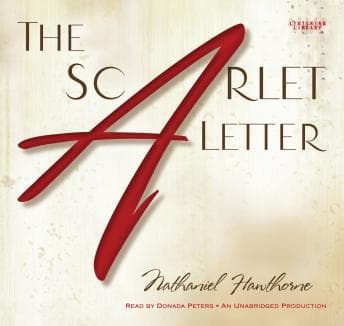

Look, I need to rant for a second. I've taught The Scarlet Letter for seventeen of my twenty years in the classroom, and every single September I watch a fresh batch of juniors decide within the first three pages that Hawthorne is their mortal enemy. "Mr. Williams, why does he use so many commas?" "Mr. Williams, what's a physiognomy?" "Mr. Williams, is this book supposed to be boring?" And every year I give the same speech about how Hawthorne isn't boring, he's dense, and density is a gift if you let it be.
So here's what I discovered listening to Donada Peters narrate this at 1.0x on my Saturday morning lakefront walk with Denise: I might have been wrong about something. Not about the book — the book is extraordinary. But about how I've been delivering it to students. Because Peters does something with her voice that I've been failing to do with my teaching for nearly two decades. She makes the Puritan world feel present tense.
The Customs-House Finally Makes Sense (No, Really)
I'll be honest — I've always half-dreaded "The Custom-House" introductory sketch. It's the part where even the Hawthorne devotees start checking their phones. But Peters treats it like what it actually is: a frame narrative with teeth. She reads Hawthorne's account of finding the scarlet cloth with this quiet intensity, like she's handling something radioactive. And suddenly you realize — oh, that's the point. The letter has weight before we ever meet Hester. I've been assigning students to "push through" the Custom-House section for years when I should've been telling them to listen to it.
The famous jail scene — the matrons gathered outside, waiting for Hester to emerge — is where Peters really earns her Golden Voice designation. She pitches those Puritan women's voices with this clipped, righteous edge that makes you feel the social machinery grinding. It's not caricature. It's more like she understands that these women aren't villains, they're instruments of a system they genuinely believe in. That distinction matters, and Peters gets it without overselling it.
Hawthorne's Sentences Were Always Meant to Be Heard
Here's the thing about Hawthorne that even English teachers forget: the man wrote for an era of reading aloud. His sentences have this rolling, almost sermonic cadence that looks intimidating on the page but sounds almost musical when spoken properly. Peters reads at a pace that honors this — not sluggish, but deliberate. The prose deserves to be savored. At just under seven hours, it's a commitment that feels earned rather than padded.
What surprised me — and I genuinely didn't expect this after teaching this novel forever — is how much more I caught Dimmesdale's psychological deterioration through audio. On the page, I tend to skim his internal passages because I know what's coming. But hearing Peters give voice to his spiraling guilt, his hand always drifting to his chest, the way his public sermons grow more powerful as his private self disintegrates — it hit differently. Let's talk about what Hawthorne is really saying with Dimmesdale: the most dangerous lie isn't the one you tell others, it's the one your community insists on believing about you.
I will say the production is straightforward — single narrator, no music, no sound effects. Just Peters and Hawthorne. For this book, that's exactly right. You don't need atmospheric scoring when the prose itself is doing all that heavy lifting. The included commentary from W.D. Howells and Carl Van Doren is a nice bonus for the academically inclined (my people), though I wished the Kathryn Harrison introduction had a bit more room to breathe.
Who Gets the A on This One
If you loved The House of the Seven Gables or Melville's more introspective passages, this is familiar territory rendered beautifully. If you're a teacher looking for a way to reconnect with a text you've taught into numbness — this is it. My students would hate this. I love it. I had a similar reaction to Under the Magnolias — the kind of book that rewards patience over pace, and that I'd enthusiastically recommend to exactly none of my juniors.
But if you need fast plot momentum or clear-cut heroes, Hawthorne isn't your guy. He's interested in ambiguity, in the space between sin and punishment where actual human beings live. Peters understands that, and she narrates accordingly.
The Red Letter Grade
I came back from my walk and told Denise I needed to rethink my entire unit plan for September. She said, "You say that every year." She's right. But this time I mean it. (I also mean it every year.) This reminds me of what Hemingway said about prose being architecture — Hawthorne built a cathedral here, and Peters walks you through it with the lights on. Worth pausing the faculty meeting for. Worth pausing everything for.









