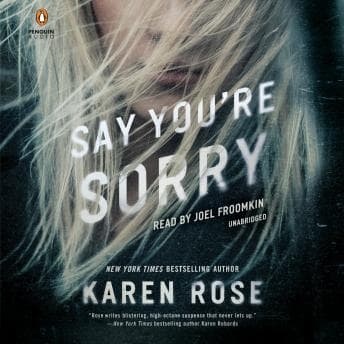

"Together they spell Sydney."
That line hit me somewhere around hour two, while I was standing over a pot of dal that I'd clearly over-spiced because I wasn't paying attention. I was too busy doing what I always do with serial killer narratives — building a psychological profile in my head, cross-referencing motive patterns, trying to figure out the "why" behind the carving. Karen Rose gave me a lot to work with. She also gave me a lot to be frustrated about.
The Killer's Mind vs. The Killer's Page Count
Let me start with what Rose does well, because she genuinely does understand something about predatory psychology that many thriller writers botch. The killer in Say You're Sorry isn't a genius mastermind operating from pure intellect. He's driven by obsession, by a fixation rooted in past trauma and a need to re-enact a specific narrative. The protagonist exhibits classic compulsive behavioral escalation — the letters carved into victims aren't trophies exactly, they're communications. He's trying to finish a sentence that started seventeen years ago. That's psychologically sound, and I found myself asking: why does he need "Sydney" specifically? Rose parcels out that answer with genuine skill.
But here's the thing — 24 hours. Twenty-four hours of audiobook. That is a commitment. And while Rose packs the book with multiple POVs, interweaving subplots, and a genuinely impressive body count, the pacing suffers under the weight of its own ambition. There are stretches where the romantic subplot between Daisy and Gideon meanders through emotional territory that feels more like filler than character development. Gideon's backstory involving a religious cult is a fascinating case study in how childhood indoctrination shapes adult attachment styles — Rose clearly did her homework on high-control group dynamics — but it's parceled out so slowly across those 24 hours that the tension bleeds out between reveals.
Daisy, to her credit, is not your standard victim-turned-love-interest. She fights back in the opening scene with genuine competence, she has her own trauma history with addiction that Rose handles with reasonable care, and she doesn't wait around for Gideon to save her. I appreciated that. What I didn't appreciate was how their romance kept pulling focus during the investigation's most critical moments. My therapist would have thoughts about Gideon's inability to separate professional boundaries from personal attachment — and honestly, so do I.
Joel Froomkin and the Problem of Twenty Characters
I need to be honest here, because the narration nearly derailed this for me. I've heard Joel Froomkin do good work elsewhere. But this book has — I lost count — easily a dozen named characters with significant dialogue, rotating POVs, and multiple investigators who all occupy similar emotional registers. And Froomkin's voice differentiation just... doesn't hold up under that pressure.
I kept losing track of who was speaking. The female voices blurred together in a way that made me rewind more than once (and I was supposed to be cooking, not rewinding). There were moments — particularly in the scenes between the FBI agents — where I genuinely could not tell if I was listening to Gideon or his partner. For a book this character-heavy, that's a real problem. Some listeners have called his performance here "cringe-worthy," and while I wouldn't go quite that far, I will say that his interpretation of certain characters felt mismatched to who they were on the page. Daisy's dialogue in particular came across flatter than it reads, which is a shame because Rose wrote her with genuine spark.
Compare this to the narration of Rose's Monster in the Closet — which apparently worked much better for many of the same listeners — and the gap is noticeable. This book needed either a dual narrator setup or someone who could create sharper vocal distinction between its massive cast.
Who Gets the Most Out of This
If you're a Karen Rose completist, you probably already have this. If you're coming in fresh, know that Rose writes long, detailed romantic suspense with real procedural elements and genuine psychological depth in her villains. The research actually shows that readers who enjoy this subgenre tend to tolerate — even prefer — longer formats because they want the full emotional arc alongside the investigation. So the length might work for you.
But if you need clear character differentiation in your audio — if you listen while running or driving or, say, making dal at 9 PM — this narration will test your patience. I'd honestly recommend the print version if you have the choice. The story earns its complexity. The audio doesn't always keep up.
My Case File Note
Karen Rose understands human nature — specifically, she understands that the worst violence usually comes from the most personal places. The cult backstory, the killer's fixation, even Daisy's recovery from addiction — these are all psychologically grounded character motivations, and that matters to me more than most people realize. I found myself doing similar character breakdowns while listening to Good Samaritan, which plays with motive and moral ambiguity in ways that kept my therapist brain fully engaged. But a 24-hour audiobook with muddled narration asks a lot of a listener's goodwill. I finished it. I'm glad I finished it. But I kept thinking about what this could have been with a different voice behind it.