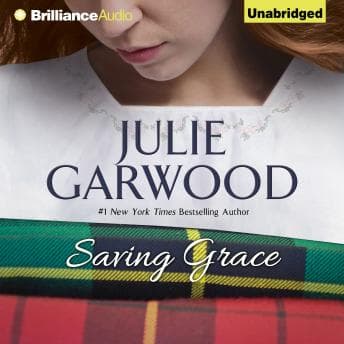

Denise and I were doing our Saturday lakefront walk — early November, that sharp Chicago wind coming off the water that makes you question every life choice — and somewhere around hour three of this audiobook, she pulled out one of my earbuds and said, "You're smiling like an idiot." She wasn't wrong. Julie Garwood's Saving Grace had me grinning through a windchill that should've been illegal.
I'll be honest: I came to this one sideways. I teach Chaucer and Hemingway and Toni Morrison. Historical romance isn't my usual lane. But here's what twenty years in a classroom teaches you — genre snobbery is just intellectual insecurity wearing a tweed jacket. Good storytelling is good storytelling. And Garwood knows exactly what she's doing.
Johanna Is the Student Who Actually Did the Reading
What got me was Johanna's voice. Not just Rosalyn Landor's performance of it (we'll get there), but the character herself. She's sixteen, widowed, and King John is basically treating her like a chess piece — remarry who I say, go where I say. And she just... doesn't comply. Not with dramatic speeches or sword fights. With quiet, stubborn intelligence. She reminded me of those students who don't raise their hands much but when they finally speak, the whole room goes silent.
Her marriage to Gabriel MacBain starts as political arrangement and becomes something warmer — but Garwood earns it. She doesn't rush the intimacy. Gabriel is gruff in the way that romance heroes often are, but there's a specificity to his tenderness that kept me from writing him off as a stereotype. He's not just "tough man learns to love." He's a clan leader who genuinely doesn't understand why his new English wife keeps reorganizing his household, and his confusion is funnier than it has any right to be.
This is what I mean when I tell my students about subtext. The humor in this book isn't joke-joke-punchline. It lives in the gap between what characters say and what they mean, between Scottish bluntness and English propriety. My students would hate this. I love it.
Rosalyn Landor Understands That Pause Is Punctuation
Let's talk about the narration, because Landor is doing real work here. Her Scottish accents are consistent — not the caricature brogue you get from narrators who learned Scottish dialect from watching Braveheart once. There's regional variation between clan members that creates a sense of actual geography. Johanna's voice is younger, less formal, slightly uncertain in early chapters, and you can hear it shift as she grows into her role as lady of the clan. That's not just reading. That's interpretation.
She's also genuinely funny. The comedic timing on dialogue exchanges — especially between Gabriel and his men — lands because Landor trusts the pauses. She lets beats breathe. At 1.0x speed (yes, I know, I'm ancient), every rhythmic choice feels deliberate.
One honest criticism: in dialogue-heavy scenes between Callum and Keith — two of Gabriel's men — I occasionally lost track of who was speaking. Their voices are close enough that when they're alone in a scene without clear dialogue tags, it gets muddy. It happened maybe three or four times across fourteen hours, so it's not a dealbreaker, but it's there. Worth noting if you're listening while distracted at, say, a faculty meeting. (Not that I would ever.)
The Prose Deserves to Be Savored, Even When It's Not Faulkner
At fourteen hours, this is a commitment. But Garwood's pacing justifies the length. The first third is setup — political maneuvering, the arranged marriage, Johanna finding her footing in the Highlands. The middle is where the romance and the humor really bloom. And the final act brings in a royal conspiracy that raises the stakes without feeling grafted on from a different book.
This reminds me of what Hemingway said about prose being architecture — Garwood builds her story with load-bearing walls in the right places. The humor supports the romance. The romance supports the political intrigue. Nothing is decorative.
If you loved Dorothy Dunnett's historical fiction but want something less punishing, this is its spiritual successor — lighter in tone, yes, but equally committed to making you care about its characters.
Who Gets an A, Who Gets Dismissed Early
Historical romance fans who value character-driven stories over breathless plot will find this deeply satisfying. If you want explicit content or dark romance, this isn't that — Garwood keeps the heat present but not graphic. Readers who dismiss romance as lesser fiction? I'd actually recommend this as a conversion text. The writing is too smart and the structure too deliberate to ignore.
Skip it if you need fast action from page one. The slow build is the point, and if that frustrates you, fourteen hours will feel like thirty.
Worth Pausing the Faculty Meeting For
I finished Saving Grace during a Sunday grading session — papers spread across the dining table, red pen in hand, Landor in my ears — and I realized I'd been staring at the same paragraph of a sophomore's essay on The Great Gatsby for ten minutes because I was too absorbed in Gabriel MacBain's latest act of bewildered devotion. The prose deserves to be savored. Garwood wrote a love story that's also a story about autonomy, about a woman choosing her own life in a world that keeps trying to choose it for her. That's why we still read the classics — and why some romances deserve to sit on the same shelf.