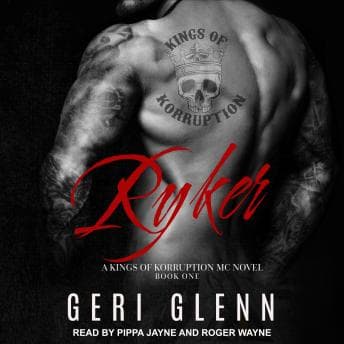

The insta-love trope is, psychologically speaking, one of the laziest shortcuts in romance fiction. And yet here I am, having just finished Ryker while chopping onions for a chana masala at 10 PM on a Tuesday, genuinely annoyed at myself for caring whether Charlotte and Ryker figure their stuff out.
Let me explain why.
The Caretaker Archetype and Why Charlotte Almost Works
Charlotte exhibits classic parentification — she's been raising her older sister Anna since childhood, absorbing everyone else's chaos so they don't have to feel it. The research actually shows that children who take on caregiver roles for siblings develop hypervigilance and an almost compulsive need to control their environments. So when Charlotte grabs Anna and runs from the Devil's Rejects MC, that tracks. That's not bravery in the heroic sense — that's a trauma response dressed up as competence. Geri Glenn might not frame it in clinical terms, but she gets the behavioral pattern right.
What's frustrating is that Charlotte's psychology is more interesting than the book lets it be. She's drawn to Ryker despite him being exactly the kind of man she should avoid — another biker, another world of violence. I found myself asking: why does Charlotte really gravitate toward danger when she's supposedly running from it? There's a rich psychological explanation there (repetition compulsion, the pull of the familiar even when the familiar is destructive), but the book doesn't dig into it. It just kind of... shrugs and says "he's hot." Which. Fine. But I wanted more.
Roger Wayne Carries This Thing on His Back
Here's where the audiobook format gets interesting. This is a dual-narration setup — Roger Wayne handles Ryker's chapters, Pippa Jayne handles Charlotte's — and the performance gap is genuinely striking. Wayne's voice for Ryker has this low, unhurried quality, almost lazy in its confidence, which is exactly right for a guy who's VP of an MC and knows nobody in the room is going to challenge him. His female voices go higher-pitched and softer but never cartoonish, and he differentiates the club brothers through intonation shifts that feel natural rather than performative.
Pippa Jayne is... fine. She's competent. But Charlotte is a character who's suppressing enormous amounts of fear and grief, and Jayne's delivery sometimes lands flat where it should be barely-held-together. The scene where Ryker finds Charlotte battered and bloody — that should be a gut-punch moment, and from Wayne's side it hits. From Jayne's side, the emotional register just doesn't quite match the severity of what's happening. I didn't skip her chapters the way some listeners apparently did (my therapist would have thoughts about that avoidance behavior, honestly), but I did notice my attention drifting during her sections and snapping back during his. At five hours and forty-two minutes, it's a quick listen, so the unevenness doesn't become unbearable. But it's there.
The MC Romance Formula — and Where This One Colors Inside the Lines
This is a fascinating case study in genre expectations versus psychological realism. MC romance has a very specific contract with its readers: dangerous man, fierce woman, violence as backdrop, protection as foreplay. Ryker delivers on all of those beats competently. The club-as-family dynamic works — the Kings of Korruption feel like a real social unit with hierarchy and loyalty codes, not just a costume for the love interest. And the external threat from the Devil's Rejects creates genuine stakes.
But psychologically, the love story moves at a pace that doesn't quite track. Ryker goes from "I don't do commitment, ever" to "I will die for this woman" with minimal internal friction. What makes a character compelling is watching them resist their own transformation — really fight it — before surrendering. Ryker's resistance feels more like a speed bump than a wall. My mother would call this "too much feelings too fast" and she wouldn't be wrong (don't tell her I said that). I ran into almost the identical problem in King: Las Vegas Bad Boys 2, where the hero's resistance to commitment collapses so fast you're left wondering if it was ever load-bearing to begin with.
The bonding moments between Charlotte and Ryker are sweet and effective in the moment. Glenn understands the small gestures — the quiet protectiveness, the way trust builds through proximity rather than grand declarations. But I kept wanting the book to slow down and let these two actually sit with their contradictions instead of resolving them so neatly.
Who Gets the Most Out of This
If you already love MC romance and you're looking for a quick, satisfying hit with strong male narration? This delivers. Roger Wayne alone is worth the listen. If you're someone who needs character motivations to feel psychologically earned rather than genre-mandated — you might find yourself arguing with the book the way I did. Which, honestly, still counts as engagement. I was never bored. Just occasionally exasperated.
Skip this if insta-love makes you break out in hives, or if you need both narrators operating at the same level. Content warnings for violence, abuse, language, and sexual content — the MC world here doesn't pull its punches.
Case File: Closed (For Now)
It's a genre-solid MC romance that knows exactly what it is, elevated by one excellent narrator and held back by one uneven one. I ate my chana masala, I finished the book, and I'm not mad about either. Am I rushing to grab book two? Not tonight. But I'm not ruling it out.