
Look, I'll admit something embarrassing. When I first heard about Divine Rivals, I dismissed it as another YA romantasy that my students would love and I'd find... fine. Serviceable. The kind of thing I'd nod politely about during class discussions while secretly thinking about Middlemarch.
I was wrong. Spectacularly, humblingly wrong.
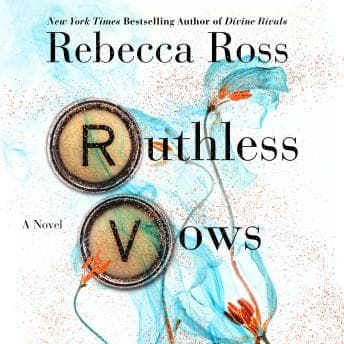
So when Ruthless Vows dropped, I dove in with actual anticipation. And here's the thing—this sequel does something that most second books in a duology fail at completely. It earns its darkness.
The Weight of Separation
Rebecca Ross understands something fundamental about romantic tension that a lot of contemporary writers forget: absence is its own kind of presence. Roman waking up in Dacre's realm with no memory of Iris, no memory of their letters, no memory of falling in love through words—it's devastating in the way good tragedy should be. Not manipulative. Just... inevitable.
The epistolary elements from the first book take on this almost unbearable quality here. You're watching two people who communicated through written words now separated by something far worse than distance. Memory. Identity. The very things that made them fall in love in the first place.
My wife Denise walked into my grading session one night and found me just sitting there, headphones on, papers untouched. "Bad book?" she asked. "Worse," I said. "Good book. Sad part." She brought me tea. She's been married to an English teacher long enough to know.
Two Voices, One Fractured Love Story
Alex Wingfield and Rebecca Norfolk split the narration duties, and mostly it works beautifully. Norfolk captures Iris's grief and determination with this quality I can only describe as controlled ache—she's holding it together, but barely, and you can hear the seams. Wingfield's Roman is appropriately disoriented, a man grasping at fragments of himself he doesn't recognize.
But here's where I have to be honest: the voice differentiation between secondary characters isn't always distinct enough. When you've got multiple POVs and a cast of supporting players, you need cleaner delineation. There were moments—particularly in group scenes—where I had to reorient myself. Who's speaking? Wait, is that Attie or someone else?
It's not a dealbreaker. The emotional beats land regardless. But if you're the kind of listener who needs crystal-clear character separation (and I know some of you are), it's worth noting.
On Patience and Pacing
Some listeners have complained about slow pacing. I get it. I do. This isn't a plot-driven sprint. It's a character-driven marathon, and Ross takes her time with the emotional geography of war, loss, and memory.
But here's my counterargument, as someone who teaches books that require patience: the slowness is the point. You're meant to feel the weight of separation. You're meant to sit in the uncertainty with Iris, to experience Roman's confusion as something that builds rather than resolves quickly. The prose deserves to be savored. That same deliberate pacing worked beautifully in Perfect Hope, where the emotional payoff justified every slow-burn moment.
(My students would absolutely hate this take. They want action every chapter. They're not wrong to want that—different books serve different purposes. But this one asks you to wait, and the waiting pays off.)
I listened at 1.0x, obviously. The author chose those words. Ross writes with a lyrical quality that gets flattened at higher speeds. If you're tempted to bump it up during the "slower" sections, resist. Trust the rhythm.
War Correspondence as Literary Device
This reminds me of what happens in the best wartime literature—the external conflict becomes a mirror for internal fracturing. The chancellor's failing city, Dacre's manipulation, the journalists trying to tell truth in a world that doesn't want to hear it. Ross is doing something genuinely interesting with the war correspondent angle. It's not just set dressing.
And the mythology woven through? If you loved the Greek-influenced divine politics of Divine Rivals, this deepens it. Dacre as an antagonist isn't cartoonishly evil—he's something more unsettling. Convinced of his own righteousness. Offering Roman healing while demanding loyalty. The god who saves you is also the god who owns you.
That's the kind of thematic complexity I didn't expect from what I initially dismissed as "just" YA romance. (Yes, I'm still embarrassed about that.) Pretties surprised me in a similar way—genre fiction doing genuinely sophisticated work with identity and transformation.
Who Should Listen (And Who Should Skip)
If you need fast pacing and crystal-clear voice differentiation, this might frustrate you. And if you're not already invested in Iris and Roman from book one, this won't convert you. But if you're the kind of person who believes love stories can also be war stories, who thinks letters between two people can carry the weight of mythology, who doesn't mind crying during your commute—this one's for you.
Mr. Williams's Final Grade
Ruthless Vows is a worthy conclusion to a duology that surprised me. The dual narration mostly elevates the material, the emotional stakes feel earned, and Ross writes with a literary sensibility that rewards close listening.
Is it perfect? No. But what is?
Worth pausing the faculty meeting for. Definitely worth ignoring those ungraded essays.