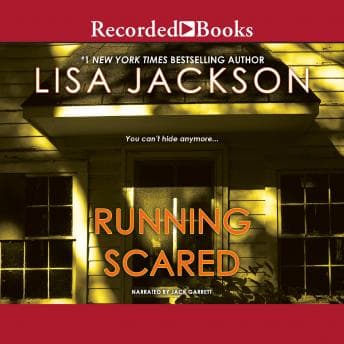

"The only person Kate can turn to has secrets of his own" — and the moment that line lands, somewhere around the midpoint of this eighteen-hour listen, I found myself standing over a pot of dal that had been simmering way too long, wooden spoon frozen in my hand, genuinely unsure whether Kate Summers was the most psychologically coherent desperate mother I'd encountered in romantic suspense or the most frustrating.
She's both. And that's kind of the point.
A Fifteen-Year Lie as Identity Architecture
Here's what Lisa Jackson gets right that a lot of thriller writers don't: Kate's secret isn't just a plot device. It's her entire self-concept. She received a baby under deeply questionable circumstances while grieving the death of her husband and daughter — and the adoption became the scaffolding she rebuilt her life around. The protagonist exhibits classic trauma bonding, not with a person but with a secret. Every decision she makes in Oregon, every friendship she builds, every morning she wakes up as "Jon's mother" — it's all contingent on the lie holding. That's not just suspense mechanics. That's identity theory.
The research actually shows that people who construct new identities around a concealed event develop what psychologists call "secret-keeping fatigue" — a chronic hypervigilance that looks exactly like what Kate displays. Jackson may not have read Slepian's work on secrecy and well-being, but she's writing it intuitively. When the mysterious man arrives in town asking questions about the boy, Kate doesn't just panic about losing custody. She panics about losing herself. That distinction matters, and Jackson earns it.
But — and this is where I started stirring the dal again, aggressively — the romantic subplot introduces a love interest whose secrets conveniently dovetail with Kate's situation in ways that strain credulity. I found myself asking: why does Daegan O'Rourke really show up the way he does? The connective tissue between his backstory and Kate's adopted son requires you to accept a density of coincidence that, psychologically, this doesn't quite track. Jackson works hard to justify it through the family dynamics — old money, illegitimate children, inheritance drama — but by hour twelve, I was doing mental math on probability rather than feeling the tension.
Eighteen Hours Is a Lot of Hours (Let's Talk About That)
This is a fascinating case study in what happens when a solid romantic suspense novel gets the full unabridged audiobook treatment. Running Scared was originally published as Wishes, and the rereleased version reportedly deepens the characters and adds suspense layers. I believe it. You can feel the expansion. Some of it is wonderful — Kate's relationship with teenage Jon is given real texture, and their mother-son dynamic carries genuine emotional weight, especially when Jon starts asking about his biological parents.
Some of it, though, is padding. There are stretches in the middle third where Jackson cycles through Kate's anxiety loops — will someone find out, what if Jon discovers the truth, is Daegan trustworthy — without actually advancing the threat. My therapist would have thoughts about this character's rumination patterns, and those thoughts would be "this is realistic but exhausting." Which, fair. Anxiety is exhausting. But in an audiobook pushing past eighteen hours, realistic anxiety spirals start to feel like the story is treading water.
Jack Garrett narrates with a steady, propulsive energy that genuinely helps during those slower stretches. He doesn't do anything flashy — no dramatic voice shifts or theatrical flourishes — but his pacing creates urgency even when the plot isn't providing it. The description of his performance as "pulse-pounding" is a bit generous; I'd call it reliably tense. He reads like a man who understands that romantic suspense lives and dies on maintaining a low hum of dread beneath the domestic scenes. He maintains that hum. I got the same reliable tension from Garrett's narration of Elantris, where his steady delivery gave a dense fantasy the feel of a political thriller. Where he's less effective is in the romantic dialogue, which sometimes lands flat — but honestly, that might be the writing more than the performance.
Who This Works For (And Who Should Run)
If you're a Lisa Jackson completist or you specifically love the "single mother with a dangerous secret" subgenre — and look, that's a robust subgenre for good reason — this delivers. I've read Lisa Jackson's Night Before, and while that story also hinges on a woman's buried secret, the psychological portrait here is more intricate. Kate is a better-drawn protagonist than you typically get in this lane. The Oregon setting has texture. The family conspiracy driving the plot is twisty enough to sustain interest even when the middle sags.
But if unrealistic coincidences in character connections bother you, or if you need your thrillers lean and tight, eighteen-plus hours is going to test your patience. I'd also note: this is very much a romance-thriller hybrid, not a pure thriller. The spice is there. The emotional beats are structured around the relationship. If you're here purely for the mystery of who's coming for Jon, you'll spend a lot of hours waiting between revelations.
I listened across a full week of cooking sessions and a couple of morning jogs, and the length worked better in those fragmented chunks than it would have in long dedicated sittings. Something to consider.
The Case File, Closed
What makes this character compelling is that Kate Summers is essentially a woman who saved herself through an act of love that was also, technically, an act of deception — and Jackson refuses to let her off the hook for the deception part. That moral complexity is the engine of the book, and it mostly runs well. It just runs a little too long. Garrett's narration keeps you in the car, but you'll notice the extra miles.