
There's a particular kind of exhaustion that comes from grading forty essays on The Great Gatsby while half your students clearly watched the movie instead. I was deep in that fog last Tuesday night, red pen abandoned, when I switched on this audiobook expecting... I don't know. Pleasant background noise about a lady and her horse.
I didn't grade another paper that night.
What Steinbeck Would Have Written If He'd Met Annie Wilkins
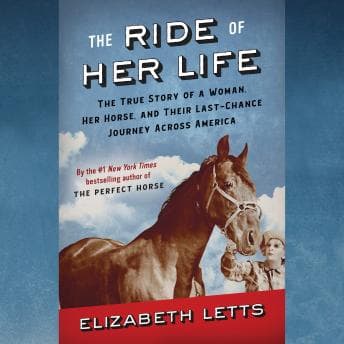
This reminds me of what Hemingway said about courage—grace under pressure. But Annie Wilkins isn't Hemingway's kind of hero. She's something older, more American in the Whitman sense. A sixty-three-year-old woman with a terminal diagnosis, no money, no family, and a stubborn refusal to die in a county charity home. So she buys a broken-down racehorse named Tarzan, straps on men's dungarees, and points herself toward the Pacific Ocean.
Without a map.
Elizabeth Letts understands that the best historical writing doesn't explain its subjects—it reveals them through accumulation. Annie's journey from Maine to California between 1954 and 1956 becomes a lens for examining an America in transition. The interstate highway system is being born. Television is rewiring how people see the world. Neighbors are starting to lock their doors. And here comes this woman on horseback, her little dog Depeche Toi trotting alongside, asking strangers for kindness and—here's the miracle—receiving it.
The prose deserves to be savored. Letts has this gift for finding the small detail that illuminates everything. Andrew Wyeth sketching Tarzan. A gas station owner in Kentucky offering Annie a job. A Wyoming rancher proposing marriage to a woman he's known for days. These aren't sentimental moments—they're evidence. Evidence that the America we think we've lost maybe never existed quite the way we remember, and also maybe still exists in ways we've forgotten to look for.
The Narration Question—And Yes, It's Complicated
Here's where I have to be honest. Tavia Gilbert's performance is passionate, committed, and occasionally... a lot. She reads Annie's story like she's performing it, which makes sense—great narration is performance art. But there were moments, particularly during emotional peaks, where I found myself wishing she'd trust the material more. The words are doing the work. Annie's story doesn't need underlining.
That said? I get why some listeners love it. If you want to feel like you're riding alongside Annie through blizzards and across mountain passes, Gilbert delivers that immersion. Elizabeth Letts also narrates portions, and the dual approach creates an interesting texture—author's voice for context, performer's voice for drama. It works more often than it doesn't.
My students would call this "extra." They're not entirely wrong. But I kept listening at 1.0x because the author chose those words, and Gilbert chose her interpretation, and who am I to rush either of them?
The Repetition Problem (And Why It Might Not Be One)
Some reviews complain about pacing—that the journey becomes repetitive. Town, kindness, road, repeat. And structurally, yes, there's a pattern. But isn't that the point? This is what Hemingway said about the Old Man and the Sea—the repetition IS the meaning. Annie's faith in human goodness gets tested over and over, and over and over, people prove her right.
If you need plot twists every chapter, you'll struggle. But if you understand that the real story is America responding to this impossible woman—that each act of kindness is its own small argument against cynicism—then the repetition becomes accumulation. Evidence stacking up.
Worth pausing the faculty meeting for? Absolutely. (Sorry again, Principal Martinez.)
Who Should Saddle Up—And Who Should Stay Home
This is for readers who loved Seabiscuit or Unbroken—stories where the historical subject becomes a prism for understanding a moment in American life. Library Book does something similar with Susan Orlean's love letter to libraries—another story about institutions that reveal who we are. It's for anyone who's ever felt like their best years are behind them and wondered if that's really true. It's for people who believe that how we treat strangers says something essential about who we are.
Skip it if you need constant action, if emotional narration makes you cringe, or if you're looking for something to half-listen to while doing other things. This wants your attention. Annie Wilkins crossed four thousand miles on horseback at sixty-three with a death sentence hanging over her. The least we can do is listen properly.
Mr. Williams's Final Grade
I started this at 11 PM expecting distraction. I finished it the next morning, having stayed up far too late, thinking about what it means to refuse the story other people write for you. Annie Wilkins was supposed to die in a charity home. She decided to see the ocean instead.
If you loved Travels with Charley, this is its spiritual successor—except Annie had less money, worse odds, and arguably more courage than Steinbeck ever needed. George Washington captures that same sense of discovering the human being behind the myth—though Washington had considerably more resources than Annie. The narration runs hot, the pacing requires patience, but the story itself is why we still read the classics. Or in this case, why we listen to new ones being born.
Denise and I are planning a lakefront walk this weekend. I'm going to tell her about Annie. She'll probably cry. I might too.
That's the kind of book this is.