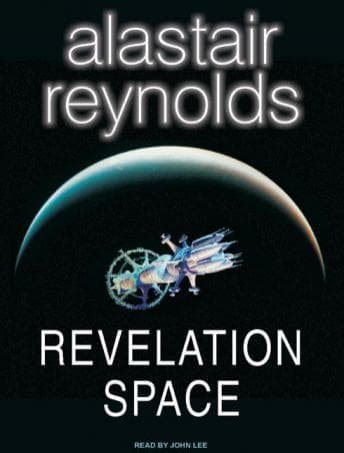

What if the reason we haven't found alien life isn't that they're not out there—but that something is hunting civilizations that get too loud?
That's the question lurking at the heart of Revelation Space, and honestly? It kept me up way past when I should've been working on my thesis. (Dr. Patel, if you're reading this, I was doing research. Sort of.)
The Fermi Paradox Gets Teeth
Look, I've read a lot of space opera. Like, an embarrassing amount. But Alastair Reynolds does something here that genuinely surprised me—he takes hard science fiction and makes it feel ancient. The universe of Revelation Space is nine hundred thousand years deep, and you feel every layer of that history pressing down on you. The Amarantin civilization was wiped out just as they were about to reach for the stars, and Dan Sylveste is obsessed with figuring out why.
Reynolds was an actual astrophysicist, and it shows. No FTL travel, no handwaving the physics. Ships take decades to cross between stars. The technology is weird and baroque—think gothic cathedrals fused with starships, crewed by people who are more machine than human. The world-building is chef's kiss. This is Sanderson-level attention to internal consistency, except instead of magic systems, you get relativistic time dilation and lighthuggers and a plague that turns people into grotesque machine-flesh hybrids.
Though honestly, I wish the character work had the same depth—Testaments: The Sequel to The Handmaid's Tale does a much better job balancing big ideas with people you actually care about.
The progression is satisfying if you're patient. And I mean patient. This is 22 hours of dense, idea-driven science fiction. If you don't like info-dumps, this isn't for you (but you're wrong). Reynolds layers mystery on top of mystery—the Amarantin extinction, the Nostalgia for Infinity's cursed crew, assassins with their own agendas—and slowly pulls them together into something that genuinely feels cosmic in scope.
John Lee: A Mixed Roll of the Dice
Here's the thing about John Lee's narration: it's polarizing. And I get it.
He's got this clear, somewhat dramatic delivery that works well for the grandeur of Reynolds' prose. When he's locked in, the pacing is solid and you can tell he understands the material. But—and this is a real but—there are stretches where the narration goes monotonous. Like, I was doing a long coding session, and I realized I'd missed an entire chapter because my brain just... drifted.
The accents are another thing. Some characters get distinct voices, which helps in a multi-POV story like this. Others? The accents feel inconsistent, or they'd shift mid-scene in ways that pulled me out. And there's this thing he does where his voice trails off at the end of sentences. Fine once or twice. Distracting when it keeps happening.
I've heard Lee is better in Chasm City (the next book in the series), and based on what I heard here, I believe it. He's clearly capable—there are moments where the emotional weight lands perfectly. It's just not consistent across 22 hours.
Also, heads up: the audio levels are uneven in places. Not dealbreaker territory, but noticeable if you're listening through headphones during a late-night session.
Who Should Board the Nostalgia for Infinity (And Who Should Skip)
This is a book for people who want their sci-fi chewy. If you're the type who reads the appendices in fantasy novels, who pauses audiobooks to look up whether the physics actually work (they mostly do), who wants your space opera to feel like it was written by someone who actually understands orbital mechanics—this is your jam.
My D&D group would love this. Specifically, our forever-DM who builds 200-page setting documents for campaigns that last three sessions. That energy.
But if you need strong character development to stay invested? Eh. The characters are more vehicles for ideas than fully realized people. Dan Sylveste is obsessive and brilliant but not particularly likeable. The crew of the Nostalgia for Infinity are fascinating concepts—cyborgs, soldiers, people running from their pasts—but they don't always feel like people you'd want to grab a drink with. Skip this one if character-driven stories are your thing, or if you're sensitive to pacing issues in narration—sample first before committing to 22 hours.
Would I Listen Again?
Yeah, probably. Maybe at 1.25x speed next time to punch through the slower sections. The ideas here are genuinely big—the kind that stick with you and make you stare at the night sky differently. Reynolds built something special with this universe, and even with the narration inconsistencies, I'm already eyeing Chasm City in my queue.
Just... not until after my thesis defense. Probably.