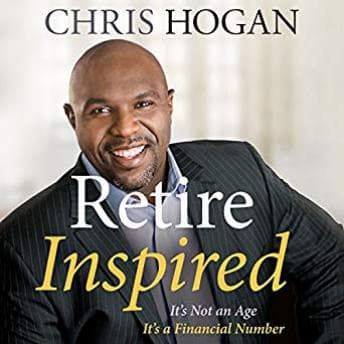

Jenny's parents are in town this week, and her dad cornered me after dinner to ask about his 401(k) allocation. I'm standing in the kitchen, loading the dishwasher, trying to explain why target-date funds aren't the worst thing in the world, and it hits me - I just spent nine and a half hours listening to a book that basically does what I was doing at that sink. Explaining retirement basics to someone who needs the push more than the specifics.
That's Chris Hogan's Retire Inspired in a nutshell. And whether that's enough depends entirely on where you are in your financial life.
Retirement Is a Number, Not a Birthday - Got It, Now What?
The central thesis is solid and worth hearing: retirement isn't turning 65 and hoping Social Security covers your Cracker Barrel habit. It's a specific dollar amount that funds the life you actually want. Hogan calls it your R:IQ - Retire Inspired Quotient - and honestly, just reframing retirement as a financial target rather than an age is genuinely useful for the 60% of Americans who have no idea what number they're aiming for.
Hogan walks through budgeting, debt elimination, investment vehicles (401(k)s, Roth IRAs, traditional IRAs), and the importance of building what he calls a "dream team" of financial advisors, insurance agents, and tax professionals. If you've never sat down and thought seriously about compound interest or the difference between a Roth and traditional IRA, this is a clean, accessible primer.
But here's the thing. If you've read The Total Money Makeover or spent any real time in the Ramsey Solutions ecosystem, you're going to feel like you're rewatching the pilot of a show you've already binged. The debt-snowball method, the emergency fund, the "be intentional" mantra - it's all here, and it's all familiar. One listener pointed out how often Hogan says "be intentional" and said it ruined his podcast for them. I counted at least a dozen instances before I stopped counting. At 2.0x speed, it started to feel like a motivational drinking game.
The Ramsey Framework With a Deeper Voice
Hogan narrates this himself, and credit where it's due - the man has a voice built for radio. Deep, clear, authoritative. There's a pastor-on-Sunday quality to his delivery that works for this kind of material. He's not rushing, he's not mumbling, and he enunciates financial terms like he actually wants you to understand them. For an author-narrated business book, this is above average.
But nine hours and twenty-six minutes is a LOT of runway for what amounts to maybe three hours of unique insight. The middle chapters - where he's walking through the basics of mutual funds and employer matching - feel padded. He'll make a point, illustrate it with a quick anecdote, then restate the point in slightly different language. Then tell you to be intentional about it. My 2.0x speed couldn't save this one from feeling stretched.
What's frustrating is that the areas where you'd actually want depth - mutual fund selection criteria, estate planning specifics, how to evaluate a financial advisor's fee structure - get surface treatment. He tells you to get a financial advisor. Great. He doesn't tell you how to know if your advisor is costing you 1.5% annually in fees that are quietly eating your returns. My parents paid a guy at their bank for years who had them in loaded funds. "Get an advisor" isn't enough. Get a good advisor and here's exactly how to vet one - that's the book I wanted.
Who This Actually Helps (And Who Should Skip to Ramsey's Calculator Instead)
Look, I've seen this pattern a hundred times with startup founders. Someone reads a motivational business book and confuses inspiration with strategy. Hogan is excellent at the former and adequate at the latter. If you're 28, have $14,000 in credit card debt, and retirement feels like something that happens to other people - this audiobook might genuinely change your trajectory. The permission to dream about retirement while being practical about getting there? That's real value.
But if you're already maxing your Roth, you understand expense ratios, and you've done the compound interest math on a napkin at 2 AM (just me?), there's not much here for you. This is Financial Planning 101, delivered with conviction and a great voice, but it's still 101. The same critique applies to Economics in One Lesson - foundational framing dressed up as revelation, though Hazlitt at least has the decency to keep it short.
This is what my parents did instinctively. Now it has a TED talk. They didn't have a "dream team" - they had a church friend who did taxes and an envelope system that kept the dry cleaning business alive. No R:IQ calculation, just the bone-deep Korean immigrant understanding that you work now so you don't work later. Hogan's packaging that instinct for a wider audience, and that's fine. But let's not pretend the packaging is the breakthrough.
The Consulting Engagement Summary
Bottom line: Retire Inspired is a solid entry-level retirement audiobook with a narrator voice that keeps you engaged even when the content doesn't. Worth it for beginners who need both the motivation and the framework. Skip it if you're already past the "what's a 401(k)" stage. Skip to chapter 5 if you want to get to the actual investment discussion faster. Thank me later.
Jenny would say I'm being harsh. Jenny is right. But she'd also agree that nine and a half hours is too long for this material. Hogan could've delivered the same value in five hours and it would've been a better book for it.