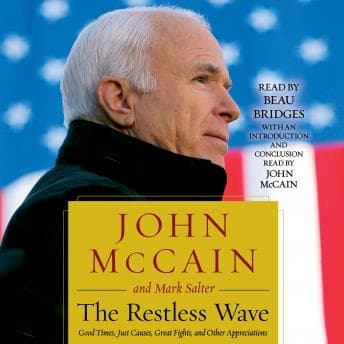

How do you write a farewell when you know it's a farewell?
That question kept circling my head as I walked the lakefront last Sunday morning, Denise a few steps ahead of me because I'd slowed down without realizing it. I was about nine hours into The Restless Wave, and McCain had just shifted from a policy argument about Syria into this quiet, almost offhand acknowledgment that he might not live to see the consequences of whatever decision Congress made. No fanfare. No dramatic pause. Just the matter-of-fact honesty of a man who's stared down worse than a prognosis.
I had to stop walking for a second. Denise turned around and asked if my knee was acting up again. It wasn't my knee.
The Last Speech You Didn't Know You Needed
Let me be upfront: this is a political book. If you're allergic to policy debates about immigration reform, campaign finance, or American interventionism, fourteen hours is a long time to be uncomfortable. McCain and co-author Mark Salter don't shy away from the weeds — there are stretches about Senate procedure and foreign policy negotiations that read like a graduate seminar in American government. My students would hate this. I love it.
But here's what surprised me: the policy isn't really the point. The policy is the vehicle. What McCain is actually doing — and what becomes clearer the deeper you get — is building an argument for a particular kind of American character. Not partisan character. Human character. The willingness to disagree with someone, fight like hell about it, and then sit down for a drink afterward. He describes his friendship with Ted Kennedy, his respect for Barack Obama even while running against him, his fury at certain Trump-era rhetoric — and none of it feels calculated. It feels like a man who knows he's running out of time and has stopped caring about what's politically convenient.
Let's talk about what the author is really saying. This isn't autobiography dressed as policy. It's an ethical argument wrapped in a life story. Geronimo's Story of His Life does something structurally similar — a man speaking directly from inside history, using his own account as an argument about what was owed and what was taken. McCain keeps returning to this idea that the country's founding principles aren't just words on parchment — they're obligations. And he says it with the urgency of someone writing his last exam, knowing there's no retake.
Beau Bridges and the Ghost in the Room
Here's the thing about the narration that nobody warned me about: Beau Bridges reads the bulk of this book, and for the first hour or so, I wasn't sure it worked. His voice has this warmth to it, almost a gentleness, that felt at odds with the McCain I'd seen on C-SPAN — the guy who could turn a Senate hearing into a boxing match with sheer cantankerousness. I kept thinking, this is too soft.
But then something clicked around hour three. Bridges isn't trying to do a McCain impression. He's capturing something closer to the private McCain — the guy writing late at night, knowing his body is failing, choosing his words with care instead of firing them like ammunition. There's a boyish quality to Bridges' delivery that works precisely because it contrasts with the gravity of the subject matter. When McCain talks about his cancer diagnosis, Bridges doesn't go for the emotional jugular. He stays steady. And that steadiness is what gutted me.
Then McCain himself shows up for the introduction and afterword, and — I'm not going to pretend this didn't hit me — hearing his actual voice, slightly rougher, slightly more halting, knowing what we know now, it transforms the whole experience. The narrator understands that pause is punctuation. But McCain's pauses aren't artful. They're real. They're the pauses of a man whose body is telling him something his mind refuses to accept.
The dual-narrator structure is unusual and a bit uneven, but I'd argue the unevenness is part of the power. You get Bridges' polished, empathetic reading as the baseline, and then McCain's own voice as the bookends — like hearing someone's eulogy and then hearing the person himself disagree with it.
Who Gets the Assignment
This is for anyone who misses the idea that political disagreement doesn't have to mean political hatred. If you loved Robert Caro's work on LBJ — that combination of granular policy detail and sweeping human drama — this is its spiritual successor, though more intimate and less panoramic. It's also for anyone who wants to understand the 2008 election and the early Trump years from the perspective of someone who was both participant and critic.
Skip it if you need constant narrative momentum. There are stretches in the middle — particularly the chapters on Syria and Libya — that feel like position papers read aloud. Important, sure. But at 1.0x speed (because the author chose those words), they test your patience.
I finished the last chapter grading papers at 11 PM on a Tuesday, red pen in hand, not grading anything. Just sitting there. Worth pausing the faculty meeting for — worth pausing pretty much everything for.
The prose deserves to be savored. And in this case, so does the silence after it ends.







![Steve Jobs [unabridged audiobook] audiobook cover](/_next/image?url=https%3A%2F%2Fcovers.audiobooks.com%2Fimages%2Fcovers%2Ffull%2F9788499923406.jpg&w=1920&q=75)