
"Resilience is not about bouncing back. It's about bouncing forward."
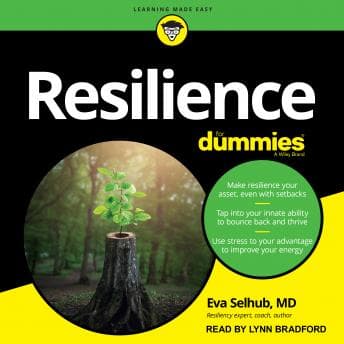
I heard some version of that line within the first hour of this 13-hour-and-53-minute audiobook, and I thought: okay, Dr. Selhub, I'm listening. Then I kept listening. For a long time. A very, very long time.
I was doing dishes when I started this one - Jenny had made her famous doenjang jjigae, which meant there were approximately forty-seven bowls to clean, and I figured a self-help audiobook was the right energy for mindless scrubbing. By the time I finished the dishes, I'd burned through about ninety minutes and was still waiting for the framework to click into place. That's not a great sign.
Six Pillars, One Problem
Here's what Dr. Selhub is actually selling: a six-pillar model - physical vitality, emotional equilibrium, mental toughness, spiritual purpose, healthy relationships, and community leadership. Solid architecture. Her Harvard Medical School background and her time running the Benson Henry Institute for Mind Body Medicine shows up in the early chapters, where she grounds the resilience framework in actual stress-response biology. The cortisol discussion, the way she connects chronic stress to physical inflammation - that section is genuinely good. That's the 45 minutes of real insight I mentioned.
The rest of the 13 hours is padding, repetition, and workshopping concepts that didn't need workshopping.
This is what my parents did instinctively. Now it has a TED talk. My father ran a dry cleaning operation in Koreatown for 25 years. He never read a book about resilience. He just got up at 5 AM every day and handled whatever came at him. The "spiritual purpose" pillar? That was church every Sunday, no exceptions. The "community" pillar? That was the Korean business association potlucks he never missed. Dr. Selhub has given academic scaffolding to lived wisdom that immigrant families have been practicing for generations. I don't say that to dismiss the book - I say it because the book should've been three hours long and it isn't.
The six-pillar framework is useful. The chapter on emotional equilibrium has a specific exercise around breath-and-body awareness that I actually wrote down (metaphorically - I was driving by this point, had migrated from the kitchen). The attachment science in Wired for Love covers similar nervous-system territory with considerably more efficiency—and it actually stuck with me past the parking lot. The leadership section, pillar six, is where she earns her consulting fees. There's a real argument in there about how personal resilience and organizational resilience are connected, and any founder I work with would benefit from that framing.
But skip to chapter 5. Thank me later.
Lynn Bradford's Steady Hand on a Long Road
Lynn Bradford is competent. That's my complete narrator review. She reads clearly, her pacing is appropriate, she doesn't do anything that makes you want to switch to the text version. But 13 hours and 53 minutes of "competent" is a long commitment. There's no texture variation between the clinical sections and the personal anecdote sections - it all arrives at the same measured, NPR-adjacent cadence. For a book about emotional equilibrium, the narration is ironically flat. I've seen narrators use vocal dynamics to make the difference between a good and great audiobook listen. Bradford doesn't reach for that. My 2.0x speed couldn't save this one from feeling long.
Who This Is Actually For
If you're a therapist, a coach, or a medical professional who wants a comprehensive framework to hand clients - this is actually a decent reference. The Dummies format works better in that context because you're dipping in and out, not committing to a linear 14-hour journey.
If you're a founder or executive who's burning out and wants a quick fix? Skip this. Read Angela Duckworth's Grit, then call your doctor.
If you're a first-time self-help listener who's never encountered the concept of resilience before? This might be exactly right. Dr. Selhub is thorough in a way that assumes nothing, which is either a feature or a bug depending on where you're starting.
Bottom line: the framework is real, the credentials are legit, and the book is twice as long as it needs to be. The key takeaway is worth the listen. The other 11 hours? Not so much. Borrow this one from your library app. Don't spend a credit.