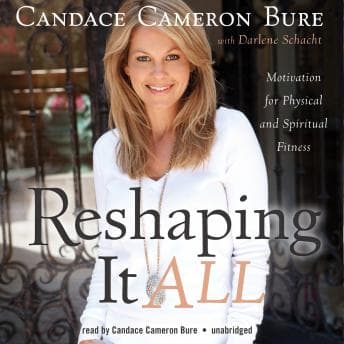

"I had to surrender my fork to God."
That's basically the thesis of this book, and I'm paraphrasing only slightly. I was on a red-eye to Denver, couldn't sleep, and figured a sub-7-hour listen about discipline and faith might hit different at 35,000 feet. It did. Just not entirely in the way I expected.
Bottom line: If you're a Christian woman looking for a faith-based pep talk about food discipline, this delivers exactly what's on the label. If you're looking for actionable fitness strategy or anything resembling nutritional science, keep scrolling.
DJ Tanner Grew Up and Found Accountability Partners
Candace Cameron Bure narrates her own book, and honestly, that's the strongest card she plays. There's a warmth to her delivery that feels like sitting across from someone at a church small group who's being genuinely vulnerable. When she talks about her struggles with bulimia during her Full House years - the pressure of being a teenager on national television, the distorted relationship with food that followed - it's real. You can hear the weight of those memories in her voice, the slight pauses before the harder admissions. That's not acting. That's a woman who lived through something and came out the other side.
The problem is that the book keeps oscillating between those candid personal moments and what amounts to a devotional workbook. Scripture passages, end-of-chapter questions, motivational reframing through a biblical lens. And look - I grew up in a Korean church where my mom would cook for 200 people after working a 14-hour day at the dry cleaners. I'm not allergic to faith-based frameworks. But Bure's approach essentially boils down to: pray for self-control, trust God with your appetite, make better choices. This is what my parents did instinctively. Now it has a TED talk. Except this one doesn't even have the TED talk's production polish.
The 45-Minute Book Trapped Inside 7 Hours
At 6 hours and 56 minutes, my 2.0x speed couldn't save this one. The core insight - that sustainable health comes from internal motivation rooted in something bigger than vanity - is solid. Bend in the Road wrestles with that same tension between external pressure and internal anchor - different context, same fundamental human problem. I've actually used a version of this framework with startup founders who burn out chasing metrics instead of mission. The parallel is real.
But Bure repeats this insight in about fifteen different ways across the runtime. Chapter after chapter circles back to the same fundamental message with a slightly different Bible verse attached. The co-author Darlene Schacht's fingerprints are visible in the structural padding - the discussion questions, the recipe mentions (which, fun fact, don't translate great to audio format - nobody's pausing their Audible app to jot down ingredient lists at minute 4:32). One negative reviewer actually said they were more interested in Schacht than Bure, which is a wild thing to say about a celebrity memoir.
The recipes and bonus content feel like they were designed for the physical book and then just... read aloud. It's like when a company takes their desktop website and calls it a mobile app. Same content, wrong format.
Where the Hustle Meets the Homily
Here's where I'll give credit: Bure is honest about the Hollywood body standard being insane, and she doesn't pretend she has it all figured out. There's a section where she talks about learning portion control not through a nutritionist's spreadsheet but through what she describes as spiritual surrender - and whether or not that framework works for you theologically, the underlying behavioral principle is sound. Changing your identity changes your habits. James Clear would approve, even if he'd use different vocabulary.
But the book struggles with audience. Is it a memoir? A devotional? A diet book? A motivational speech? It tries to be all four and doesn't fully commit to any. Jenny would say I'm being harsh. Jenny is right. But also Jenny would've finished this book and felt encouraged for about 48 hours before the specific advice faded because there isn't much specific advice to retain.
I've seen this pattern in business books too - the ones that mistake inspiration for instruction. You walk away feeling good but you can't name three things you'd actually do differently tomorrow morning.
Who Gets the ROI
If you're a Christian woman who connects with faith-based motivation and you want someone relatable to walk alongside you on a health journey, Bure's voice - literally her voice, narrating - makes this a warm companion listen. She's not preachy in the aggressive sense. She's preachy in the "your cool older sister who found Jesus and Pilates" sense.
If you're looking for a business-of-self optimization book, or anything with data, research citations, or a structured methodology, this is not your book. And if you're not Christian, about 60% of the content won't land.
Skip to chapter 5. Thank me later. That's where the bulimia disclosure happens and the book briefly becomes the memoir it should've been the whole time.
The Consulting Debrief
The key takeaway is worth the listen. The other 6 hours? Not so much. Bure's narration is the product's competitive advantage - sincere, personal, unpolished in a way that works. The content itself needed a tighter edit and a clearer sense of what it wanted to be when it grew up. My parents would've appreciated the discipline message. They would've skipped the recipes.