
"History, huh. Bet we could make some."
That line - or something close to it - hit me somewhere around hour seven, and I had to stop walking. Just stood there on the lakefront path like a fool, Denise two steps ahead before she turned around and gave me that look. The one that says "you're having a moment about a book again, aren't you."
Yes. Yes I was.
The English Teacher Who Didn't See This One Coming
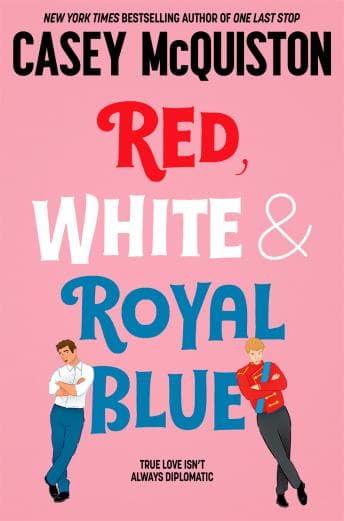
Look, I'll be honest. I picked up Red, White & Royal Blue because one of my juniors left it on her desk with a Post-it that said "Mr. Williams you NEED this" and three underlined exclamation marks. I teach Fitzgerald and Morrison and Achebe. I was skeptical. A rom-com about the First Son of the United States falling for the Prince of Wales? This felt like it belonged in a different teacher's wheelhouse.
I was wrong. And I'm big enough to say it.
Casey McQuiston wrote something that functions on two levels simultaneously - yes, it's a love story with all the giddiness and heat you'd expect, but underneath that, it's a genuinely sharp political novel about identity, about the weight of public expectation, about what it costs to be yourself when yourself belongs to an entire country. The emails between Alex and Henry aren't just flirty - they're literary. McQuiston weaves in references to history and queer identity that feel earned, not performational. There's a scene where Henry essentially bares his soul through the lens of historical figures who had to hide, and it carries real weight. My students would probably roll their eyes at me calling a romance "thematically ambitious," but here we are.
The pacing front-loads a lot of setup - the fake friendship, the political machinery, the ensemble cast of handlers and family members. I noticed something similar reading Fall of Shane MacKade - that same deliberate slow burn where the early pages feel almost stubbornly unhurried, and then suddenly you realize the groundwork was load-bearing the whole time. The first few hours ask for patience. But McQuiston is doing something deliberate: she's building the scaffolding so that when it falls away and these two are just... two people figuring themselves out, it hits different. If you loved Maurice by E.M. Forster - and I mean the ache of it, the impossibility of it - this is its spiritual successor wearing a campaign button and sneakers.
De Ocampo's Tight Rope Walk
Ramón de Ocampo has an interesting challenge here, and I want to be fair about where he lands. He's one narrator carrying what feels like fifteen distinct characters across twelve-plus hours. His Alex gets a hint of Texas energy that works - not a full drawl, more like the vowels open up just enough to place him geographically. His Henry is where things get tricky. The British accent wobbles. It's endearing in a way that sort of mirrors Henry's own uncertainty about himself, but I don't think that was intentional. There were two or three spots - particularly in group scenes with multiple speakers - where I genuinely lost track of who was talking. A line I'm pretty sure belonged to Nora came out of a voice I'd been tracking as June, and I had to rewind.
But here's what De Ocampo absolutely nails: the quiet moments. The narrator understands that pause is punctuation. When Alex is processing something enormous about himself - when the bravado drops and there's just this kid realizing who he is - De Ocampo slows down, lets the silence do work. His comedic timing on the banter is sharp too. The back-and-forth texting sections pop with this rapid-fire energy that made me actually laugh out loud during a faculty meeting. (Principal Martinez, I promise I was reviewing assessment data. I wasn't. I was listening to the First Son of the United States sext the Prince of Wales.)
I'll note this: some listeners find his voice nasal, especially in the opening hours. I noticed it, adjusted, and it stopped bothering me by hour three. Your mileage may vary.
Who This Is For (And Who Should Maybe Wait)
If you want something light and breezy with zero demands on your attention, this isn't quite that. The political ensemble is dense, and a single narrator means you need to track voices actively. It rewards focus. But if you're someone who loves a romance that also wants to say something about power, about being seen, about choosing authenticity when the safe move is silence - this book earns its twelve hours.
Skip it if: dialogue-heavy books with one narrator frustrate you, or if you need your British accents airtight. Come back to it if: you've ever felt like the person you are in private and the person you are in public are running for different offices.
Worth Pausing the Faculty Meeting For
I started this as a favor to a seventeen-year-old. I finished it genuinely moved. McQuiston wrote a book that believes in the radical possibility of honesty, and De Ocampo - wobbly vowels and all - delivers it with real heart. The prose deserves to be savored, even when it's dressed in red, white, and blue sequins. I'm keeping it on my shelf next to Forster. My student is going to be insufferable about this, and she's earned it.