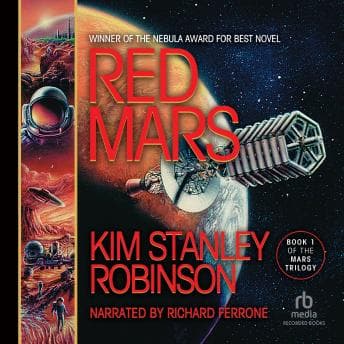

Bottom Line: Worth your commute if you're ready to commit. This is basically a 24-hour masterclass in terraforming disguised as a novel.
Okay, so here's the thing about Red Mars: I started this during a particularly brutal week of on-call rotations, and I'm pretty sure it actually made me a better engineer. Not because it taught me anything about distributed systems, but because after 23 hours of listening to scientists argue about the ethics of planetary transformation, my production incidents felt... manageable?
I finished this in roughly two weeks of commutes, and I have thoughts.
The Science Actually Holds Up (Mostly)
Look, I'm not a planetary scientist, but I work with enough PhDs to know when someone's done their homework versus when they're just throwing jargon at a wall. Kim Stanley Robinson clearly spent years researching this. The terraforming debates, the political factions, the actual engineering challenges of building a civilization on Mars—it's all grounded in real science extrapolated forward.
The problem? Sometimes it feels like you're listening to a very well-written textbook. There are passages where Robinson describes geological formations for what feels like twenty minutes. I'm not exaggerating. I timed one section about areology (that's Mars geology, I learned) at nearly fifteen minutes of pure description. Beautiful, sure. But at 6 AM on a packed Caltrain, surrounded by other zombies? I zoned out more than once.
This is where the 1.5x speed becomes non-negotiable. At normal speed, this book would've taken me a month. At 1.5x, the descriptive passages become almost meditative background, and the character drama hits harder.
Richard Ferrone's Voice Carried Me Through
Richard Ferrone has this deep, resonant voice that somehow makes arguments about nitrogen fixation sound dramatic. And there are a LOT of arguments in this book. Political arguments, scientific arguments, philosophical arguments about whether humans have the right to change another planet. Ferrone gives each debate weight without making it feel like a lecture.
His character work is solid but not perfect. He's got distinct voices for the main players—I could always tell when we were with Maya versus Ann versus John. But honestly? Some of the secondary characters blend together, and there's this vaguely New York accent that creeps into characters who definitely shouldn't have it. A Russian scientist with a Brooklyn twang is... a choice.
Also, fair warning: there are some mispronunciations of space terms that made me wince. Minor stuff, but if you're a space nerd, you'll notice.
The Slow Burn That Actually Pays Off
This isn't a thriller. This isn't even really an adventure story, though there are adventure elements. It's the kind of deliberate, world-building-heavy narrative I also found in Ship of Magic, where the payoff requires patience. It's a slow, methodical exploration of what happens when you put 100 brilliant, flawed humans on a planet and tell them to build a new world.
The first third dragged for me. I'll be honest. The setup, the voyage, the early colonization—it felt like Robinson was laying groundwork for something bigger. And he was. By the final third, when the political tensions explode and everything the characters built starts to fracture, I was genuinely invested. There's a sequence near the end that I won't spoil, but I missed my stop because I couldn't pause.
Perfect for: long commutes, gym sessions where you want to zone out, weekend road trips. Skip for: anything requiring split attention. This demands focus.
Who Should Queue This Up (And Who Should Skip)
If you loved The Expanse and wished it had more actual science and less space battles, this is your book. If you're the kind of person who reads Wikipedia articles about proposed Mars missions for fun (no judgment, I've been there), you'll love this. If you want action and tight plotting, you'll probably bail by hour five.
The ROI on this audiobook is high if you're in the right headspace. It's genuinely changed how I think about long-term systems—and I don't just mean planetary ones. There's something about spending 24 hours with people trying to build something that lasts centuries that makes you think differently about the code you're shipping. The Drawing of the Three had a similar effect on me—different genre entirely, but that same sense of characters building something bigger than themselves stuck with me for weeks.
The sex scenes are... present. And sometimes weird in audio format. Just a heads up. I was on a crowded train for one particularly graphic scene and had to do the awkward "pretend I'm listening to a podcast about productivity" face.
Commit or Rollback?
Probably not a full re-listen—it's too long when my backlog is this deep. But I've already started Green Mars, so clearly something stuck. Ferrone continues narrating the trilogy, and honestly, his voice has become the voice of Mars in my head now.
If you're on the fence, sample the first hour. If the pacing doesn't immediately annoy you, you'll probably make it through. If you're already checking your phone by minute thirty, this isn't your book. And that's fine. Not everything needs to be for everyone.