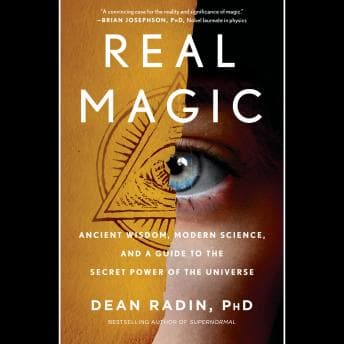

Look, I need to rant about something. Dean Radin has a PhD, worked on the literal government psychic spy program (Stargate - yes, that was real), and has been running controlled experiments for 40+ years. So why does he spend the first three hours of this book basically apologizing for his own research? I get it - psi research is the redheaded stepchild of science, and anyone who touches it gets side-eyed by the entire academic establishment. But the constant defensive crouch got exhausting. It's like watching a senior engineer preface every architecture review with "I know this sounds crazy, but..."
Once I got past that frustration, though? There's actually something interesting here.
The Peer-Reviewed Woo-Woo Problem
I started this at like 5:45 AM on a Thursday, half-dead after a late-night deploy went sideways, and honestly the first chunk almost lost me. Radin walks through the historical context of magic - hermeticism, kabbalah, the Western esoteric tradition - and if you're not already familiar with that world, it feels like drinking from a firehose of proper nouns. But here's where it gets genuinely interesting: when he pivots to the meta-analyses of psi experiments, the guy is rigorous. He breaks down effect sizes, discusses the file drawer problem, addresses replication concerns. This is not some "raise your vibration" self-help fluff. He's literally citing double-blind randomized controlled trials from peer-reviewed journals and walking you through the statistics.
The core argument is that consciousness isn't just a byproduct of brain chemistry - it's fundamental to reality, and phenomena like telepathy, precognition, and psychokinesis are natural (if small) effects that show up consistently in controlled lab settings. He draws on quantum mechanics (specifically entanglement and the observer effect) to build a theoretical framework. Now - does the quantum stuff hold up? Eh, it's where he gets hand-waviest. As someone who took two quarters of quantum mechanics at UW and promptly forgot 90% of it, I can tell you he's doing that thing where popular science writers use quantum weirdness as a magic wand (pun intended) to explain anything mysterious. The actual physics community would have opinions about this.
But the experimental data chapters? Those are genuinely compelling. He discusses the ganzfeld telepathy experiments, random number generator studies, and presentiment research where subjects' physiological responses predicted the emotional content of images they hadn't seen yet. The effect sizes are small but statistically significant across hundreds of studies. It's the kind of thing where my engineer brain goes "okay, there's signal here, even if the mechanism is unclear."
Mark Bramhall Makes the Medicine Go Down
Bramhall is exactly the right narrator for this. The guy has an Audie Award for good reason - his voice has this calm, authoritative quality that makes even the more out-there claims sound like a reasonable professor explaining something over coffee rather than a guy on a street corner with a sandwich board. He reads the statistical passages with the same measured clarity as the mystical history sections, which is harder than it sounds. A lesser narrator would either ham up the esoteric stuff or bore you to tears during the data analysis. Bramhall threads that needle.
That said, at 8 hours, the pacing drags in the middle section where Radin covers the practical "how to do magic" exercises. These are basically meditation and focused intention techniques, and hearing someone describe how to visualize energy flowing through your hands is... not great audio content. I had the same problem with Stress Relief Meditations, where the guided exercises are almost comically awkward to follow on a crowded train. This is the one section that probably works better in print where you can actually do the exercises instead of sitting on a train surrounded by people who'd definitely judge you for closing your eyes and "directing your chi" or whatever.
Who This Is Actually For (And Who Should Run)
If you're a materialist atheist who thinks anything outside the standard model is garbage, this book will make you angry. If you're already deep into crystals and tarot and don't need convincing, you'll find the scientific framing either validating or too conservative. The sweet spot - and where I landed - is if you're a science-minded person who's curious about the edges of what we understand about consciousness. Someone who can hold "this is weird" and "but the data is interesting" in their head simultaneously.
Kevin, who is an aggressively skeptical mechanical engineer, overheard about 20 minutes of this and declared it "fancy pseudoscience." I made him listen to the meta-analysis chapter. He's now "cautiously annoyed that it's not as easy to dismiss as he wanted." Which honestly might be the best endorsement I can give.
The ROI on this audiobook is decent but conditional. If you want a rigorous (if controversial) overview of psi research from an actual scientist, it delivers. If you want practical life-changing techniques, it's thin. If you want hard sci-fi level speculation about the nature of consciousness, the last two hours get genuinely wild in a good way.
Debug Level: Interesting Signal, Noisy Channel
TL;DR: Worth your commute - with caveats. This is basically a well-cited research paper dressed up as a self-help book, which means the science parts are better than expected and the self-help parts are worse. I finished it in 4 commutes at 1.5x and spent the rest of that week reading arguments about it online, which is either a recommendation or a warning depending on your personality.
Perfect for: commute, focused listening when you want something to chew on. Skip for: gym (too data-heavy), bedtime (you'll either fall asleep during the stats or lie awake questioning reality).