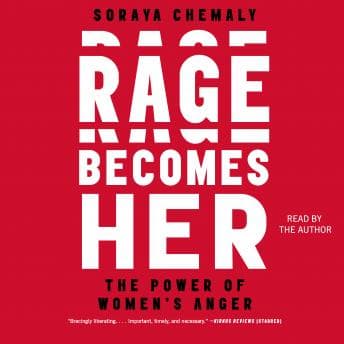

I put this on during a long Saturday of cooking — dal simmering, rice on the back burner, the kind of afternoon where you're half-present and half somewhere else. That was a mistake. Not because the book is bad. Because you cannot be half-present for this one. I burned the dal. Worth it.
Soraya Chemaly narrating her own work is the right call here, and not just for the obvious reasons. There's a specific moment — she's talking about her mother, about watching her suppress and redirect anger her entire life, the way that suppression became a kind of inheritance passed down without anyone intending it — and the way Chemaly's voice shifts in that section is something a hired narrator couldn't have replicated. It's not performed grief. It's the real, slightly-controlled thing. You can hear her choosing her words carefully, which is somehow more affecting than if she'd just let it go. The research on emotional labor has a name for what she's describing: the chronic suppression of negative affect in women correlates with measurably worse health outcomes. Chemaly knows this. She's citing the studies. But she also lived adjacent to it. That combination — the data and the personal — is what makes the eleven hours feel necessary rather than exhausting.
The Part Where I Got Annoyed (Academically)
I want to be precise about what this book is doing psychologically, because I think it gets misread. This is not a book telling women to be angrier. That framing frustrates me every time I see it in reviews. What Chemaly is actually arguing — and the research actually shows this — is that anger is an appraisal emotion. It fires when we perceive injustice or a violation of what we believe we deserve. When women are systematically trained to misread their own anger signals — to reinterpret them as anxiety, sadness, or personal failing — they lose access to accurate information about their own environments. That's not empowerment rhetoric. That's cognitive science. Murakami gets at something adjacent to this in Men Without Women — the way emotional misdirection becomes a structural feature of how men and women relate to each other, except he's tracing the damage from the outside looking in, which is its own kind of useful.
The chapter on how girls are socialized to redirect anger into self-directed emotion (anxiety, depression, eating disorders) while boys are permitted to externalize it — I found myself asking: why does this pattern persist so reliably across cultures? Chemaly's answer is structural, which is correct. But I kept wanting her to go one layer deeper into the developmental psychology. She gets close. She doesn't quite get there. That's my one genuine complaint: the book occasionally treats the research as confirmation of the argument rather than the source of it. Minor. But I noticed.
The section on how women's anger reads as pathological in medical and psychiatric contexts — where the same symptoms get coded differently depending on the patient's gender — that one I will be thinking about for a while. My therapist would have a lot of thoughts about that chapter specifically.
Who This Is Actually For
If you already have a solid grounding in feminist theory, some of this will feel like familiar territory. You'll still find value in the synthesis — Chemaly is pulling from psychology, sociology, neuroscience, and political history simultaneously, which is genuinely impressive — but you won't be shocked. If you're newer to thinking about gender and emotion as interconnected systems, this could be a fairly significant recalibration of how you understand your own emotional history.
Do not listen to this as background. Do not put it on during a commute where you'll be interrupted. The argument builds. The personal anecdotes about her daughter — watching the next generation navigate the same suppression patterns — only land if you've been tracking the argument for a few hours. Give it the focused attention it's asking for.
I gave the dal a respectful funeral and made eggs instead. Some books are worth the collateral damage.