
What do you do with a book that knows exactly what it is and refuses to apologize for it?
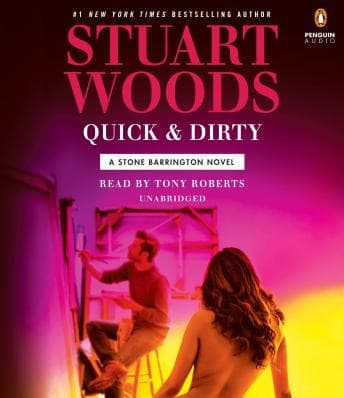
I was walking the lakefront with Denise last Saturday — one of those rare October mornings where Chicago decides to behave itself — and I had Quick & Dirty playing through my earbuds. She asked me what I was listening to, and I said, "It's like if a really expensive martini were a novel." She laughed. But I meant it. This is a book that goes down smooth, doesn't ask much of you, and leaves you pleasantly buzzed without any real hangover.
Stuart Woods wrote the Stone Barrington series the way some painters do hotel lobby art: competently, prolifically, and with absolute confidence that there's an audience waiting. And there is. I've dipped into Barrington before — this is book 43, which is a number that should make any English teacher weep with either admiration or existential dread — and Quick & Dirty delivers exactly what regulars expect. Stone gets a new client, a beautiful widow whose husband died under suspicious circumstances. There's art forgery. There's the art world's particular brand of genteel sleaze. There are dinners at Patroon and trips to the Hamptons. Stone sleeps with someone by chapter three. The sun rises. The sun sets.
The Art World as Set Dressing (And Why That's Fine)
Let's talk about what Woods is really saying — or more accurately, what he's choosing not to say. The art world stuff here is surface-level. You get some details about stolen paintings, fencing operations, the economics of forgery versus authentication. But Woods isn't interested in the deep psychology of why someone would kill for a canvas. He's interested in moving Stone from one luxurious setting to the next while things occasionally explode or get legally complicated. The tension-filled dinners with Dino and the widow client have a certain snap to them — Woods knows how to write dialogue that clips along like good banter at a cocktail party. It's not Hemingway's iceberg theory, but the man understood rhythm.
My students would hate this. I love it. Not because it's great literature — let's be honest with each other — but because sometimes you need a book that functions like a well-oiled machine rather than a meditation on the human condition. At 7 hours and 43 minutes, it's the literary equivalent of a weeknight dinner: nothing fancy, but it hits the spot.
The problem is the pacing early on. The first hour or so crawls in a way that had me actually paying attention to Principal Martinez's email about hallway supervision protocols, which tells you something. Woods takes his time setting the table, and for a book this short, that's a luxury he can't quite afford.
Tony Roberts: Charm With a Caveat
Tony Roberts narrates these Barrington books with the breezy confidence of a man who's been doing this long enough to find the character in his sleep. And that's both the strength and the weakness. His Stone Barrington is smooth, authoritative, exactly the voice you'd expect from a guy who has a private jet and a law degree. His comedic timing is genuinely good — there are moments where Roberts lands a dry aside with the precision of a stage actor, which makes sense given his theater background.
But here's the thing I can't unhear: his female voices. They're rough. Not "charming rough" or "endearingly limited" — more like someone doing an impression of a woman at a dinner party and the whole table going quiet. The widow character deserves better than the slightly nasal, vaguely strained register Roberts gives her. And Dino — Stone's perpetual sidekick — gets a voice that sounds like someone doing a Brooklyn accent through a head cold. Some listeners love it. I found myself wincing about every third Dino scene.
(Also, and this is petty, but Roberts pronounces "airplane" as "air-o-plane" at one point, which — Tony. Tony, no.)
The narrator understands that pause is punctuation, and Roberts does use silence well in the tenser moments. But the character differentiation issues are real enough that I'd dock him for it. He's a 3-out-of-5 narrator doing 4-out-of-5 work about 60% of the time.
Who's Pouring This Martini For
If you're already in the Stone Barrington universe, you know what you're getting and you'll enjoy it. If you loved the earlier books — New York Dead, the ones with more edge — this one's going to feel like the series on cruise control. It's comfort listening. Airport reading in audio form.
If you're coming to Stuart Woods fresh, don't start here. Start with Chiefs, which won the Edgar for a reason, or at least the first Barrington novel. Starting at book 43 is like walking into a sitcom during season 12 — you can follow it, but you've missed why anyone cares.
Skip if: you want literary fiction, complex character arcs, or narration that handles women's voices with any grace. Love Letter landed in similar territory for me — pleasant enough, knows its audience, but the narration left me with some of the same reservations about character voice.
Listen if: you want something pleasant and undemanding that pairs well with a lakefront walk, a glass of bourbon, or — hypothetically — a faculty meeting about budget allocations.
The Grade I'd Write in Red Ink
This is a B-minus book with C-plus narration and an A-plus understanding of its own audience. Woods wasn't trying to write The Goldfinch. He was trying to write the 43rd Stone Barrington novel, and he did. The prose doesn't deserve to be savored so much as sipped. I listened at 1.0x out of principle, but honestly? This one could handle 1.25x without losing anything. And that tells you something about the weight of the sentences.
Worth pausing the faculty meeting for? Barely. Worth a lazy Saturday walk? Absolutely.