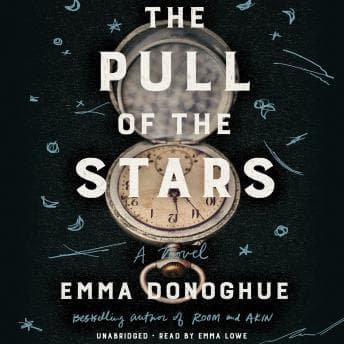

I was up at 2 AM finishing a logo revision I'd been putting off — the kind of mindless color-tweaking work where your hands move but your brain is somewhere else entirely — and I made the mistake of starting this book. By 4 AM I was sitting cross-legged on my kitchen floor with Frida in my lap, tears running into my cold coffee, listening to a woman in 1918 Dublin try to keep a dying mother's baby alive while the flu ate through the ward like fire through paper.
This book felt like being locked in a room with people you're terrified to love because you know what's coming.
Three Days, One Ward, and All the Air Sucked Out
Here's the thing about Pull of the Stars — it takes place over just three days. Three. The entire novel is basically contained in a single overcrowded maternity ward during the 1918 flu pandemic. And Donoghue does something gutsy with the structure: there are no chapter breaks. It's one continuous stream, which on audio creates this claustrophobic, almost suffocating rhythm. You're stuck in that ward with Nurse Julia Power the way she's stuck in it. No relief. No cutting away to a subplot in a sunlit garden somewhere.
And that choice — which I've seen some listeners say made their attention wander — is exactly what made it hit me so hard. Because the monotony IS the point. The repetitive motions of checking temperatures, changing sheets, holding basins. Julia does these things over and over, and then suddenly a mother hemorrhages or a baby won't breathe and the monotony shatters into chaos. The pacing mirrors what pandemic work actually feels like: boring boring boring CRISIS boring boring GRIEF. Three Day Road does something similar with trauma rhythm — that same accumulation of quiet endurance punctuated by violence that you can't look away from.
Some people found the narrative style rough or hard to stick with, and I get that. If you need propulsive plot mechanics, this isn't that. But if you can sit with the rhythm of it — really sit with it at 1.0x, which is the only way I'd recommend — it becomes almost hypnotic.
Emma Lowe Made Me Forget I Was Listening to One Person
Okay, let me talk about Emma Lowe because she deserves her flowers. Her Irish accent work here isn't just "oh she sounds Irish" — she uses the accent as a class marker in ways that genuinely inform the characters. Julia's voice has this careful, educated diction, like someone who worked hard to sound professional. Bridie Sweeney, the young volunteer from the tenements, comes through softer and rougher around the edges, and you can hear the poverty in her vowels without Lowe ever making it cartoonish. And Dr. Kathleen Lynn — the real historical figure, the rebel doctor — gets this clipped, purposeful delivery that radiates someone who's done being patient with a system that's failing.
Lowe imbues Julia with this specific mixture of determination and self-doubt that just — my heart. MY HEART. There's a moment where Julia realizes she's been doing something medically wrong, something that might've contributed to a patient's suffering, and the way Lowe's voice cracks just slightly on the realization? Not dramatic. Not showy. Just this tiny fracture. I had to pause.
(I ugly-cried at least three separate times, for the record. Spreadsheet updated.)
The Quiet Love Story Abuela Would've Clutched Her Rosary Over
I'm not going to spoil the romance because it unfurls so gently that spoiling it would be a crime. But the connection between Julia and Bridie builds in these tiny stolen glances and accidental touches in a cramped ward where they're literally elbow-deep in life and death. It's queer love in 1918 Catholic Ireland, which means it lives entirely in the margins — in what's NOT said, in the electricity of proximity. The chemistry is chef's kiss precisely because it's so restrained. When something finally does happen, it's so earned that I felt it in my sternum.
And Donoghue — who is herself an Irish woman writing about queer love in historical settings — never makes it feel like she's importing modern sensibilities. Julia's confusion and longing feel period-appropriate without being punishing. That's such a hard balance.
Abuela would have loved this one. She would've been scandalized and riveted in equal measure, the way she was with her telenovelas — gasping at the love story, praying over the dying mothers.
Who Gets to Come Into the Ward
This is for you if: you love character-driven historical fiction, you want a pandemic novel that feels visceral without being exploitative, you appreciate slow-burn queer romance, or you just need a book that trusts you enough to sit in the hard parts. This is a rainy Sunday book. A lights-off, headphones-on, don't-talk-to-me book.
Skip it if: you need fast pacing or clear chapter breaks to stay engaged, or if graphic medical events (childbirth complications, flu deaths, references to abuse) are too much. The content warnings on this one are real.
The Last Thing I'll Say While Sitting on This Kitchen Floor
Pull of the Stars is not a comfortable listen. It's heavy and sometimes airless and it asks you to care about people who might not make it. But the vibes are immaculate in that devastating, beautiful way — like candlelight in a room where someone is praying. Nine hours. Three days. A whole world cracked open.