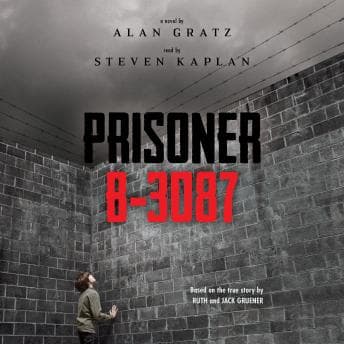

How do you even review a book about surviving ten concentration camps without sounding like you're writing a book report? Seriously. I sat with this one for a while after it ended, just staring at my screen like an idiot while my thesis document blinked at me accusingly.
Look, I mostly listen to fantasy. Give me a Sanderson magic system or a LitRPG stat block and I'm happy. But sometimes you need something that punches you in the gut and reminds you that real history is darker than any grimdark fiction I've ever consumed. Prisoner B-3087 is that punch.
The Weight of a True Story
Alan Gratz based this on the actual experiences of Jack Gruener, and you feel that truth in every chapter. This isn't some author imagining what the Holocaust might have been like—this is what actually happened to a real kid. Yanek gets shuffled through TEN different concentration camps. Ten. Each one a new nightmare. Each one a new way to almost die.
What got me was the pacing. At just under five hours, Gratz doesn't waste a single minute. There's no filler here, no meandering subplots. It's survival, pure and simple. Move. Starve. Work. Almost die. Repeat. The progression (and yeah, I'm using that word intentionally) feels almost like a dark inverse of the LitRPG stuff I love—except instead of leveling up, Yanek is just trying to stay alive long enough to see tomorrow.
My D&D group would probably call this a survival campaign with the difficulty cranked to impossible. Except there's no dice rolls. No saving throws. Just luck and will and the horrible randomness of who lives and who doesn't.
Steven Kaplan Brought the Pain
I couldn't find a ton of info on Steven Kaplan's other work, but based on this performance? The guy knows what he's doing. One listener described his delivery as "croaking while saying his dialogues, as if stopping himself from crying" and yeah—that's exactly it. There's this rawness to it that never feels performative.
He doesn't do big theatrical voices or anything. This isn't Steven Pacey doing seventeen distinct characters. Kaplan's approach is more... intimate? Like he's telling you this story quietly, seriously, because it deserves that respect. The emotional delivery hits without being manipulative. You can hear Yanek's helplessness. You can hear his pain. And somehow, you can also hear those tiny moments of hope that keep him going.
The pacing is spot-on too. He knows when to let a moment breathe and when to push forward. At 4 hours 46 minutes, this is a quick listen, but it never feels rushed.
Who This Is For (And Who Should Wait)
Here's the thing—this is technically a kids/YA book. It won the Junior Library Guild Selection and a bunch of state awards. But don't let that fool you. The content is heavy. Violence, abuse, the brutal reality of what happened in those camps. Tattooist of Auschwitz covers similar ground with a slightly different lens—more focused on one camp, one story of survival and love. Gratz doesn't shy away from it, even while keeping it accessible for younger readers.
If you're an educator or parent looking for a way to introduce the Holocaust to kids who are ready for it? This is Sanderson-level world-building in terms of how well it constructs this historical nightmare in an understandable way. (Okay, weird comparison, but you know what I mean.) It's historically grounded without being a textbook.
But if you need something light right now? Skip this. Come back when you're ready. There's no shame in that.
I listened to this during a late-night coding session when I should've been working on my thesis. (Dr. Patel, if you're reading this—I was taking a mental break. Definitely.) By the end, I wasn't coding anymore. I was just... sitting there.
Roll for Emotional Damage
Yes, it's under five hours. Yes, it's worth it. Yes, you'll need a minute afterward.
The real Yanek survived. He made it. Knowing that going in doesn't make the journey any less harrowing, but it does give you something to hold onto. And honestly? That's what makes this work as an audiobook. You're there with him, in his head, through every camp. Kaplan makes sure of that.