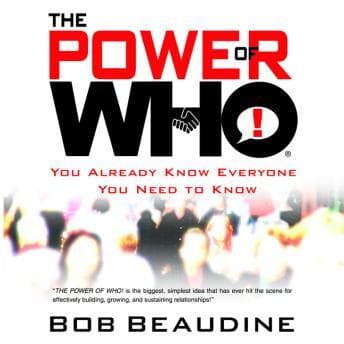

"You already know everyone you need to know."
That's the central thesis. I was chopping onions for a chana masala at 9 PM on a Tuesday - the kind of evening where you're too tired to read but too wired to sleep - and Bob Beaudine said that line with such conviction that I actually put down my knife. Because psychologically? That's a bold claim. And my brain immediately went into researcher mode: Is this true? Under what conditions? For whom?
Let me walk you through where I landed after five hours with this guy.
The 100/40 Principle, or: Dunbar's Number Gets a Motivational Makeover
Here's what Beaudine is actually arguing. You have roughly 100 people in your broader circle and about 40 in your inner world - friends, family, close colleagues. Instead of cold-networking your way through strangers at conferences (which, as an introvert who has white-knuckled her way through many an academic mixer, I deeply appreciate), he says you should activate the relationships you already have. Your "Who" - the people who genuinely care about you - are the ones who'll open doors.
The research actually shows he's not entirely wrong here. Social psychology has long established that weak ties (Granovetter, 1973, if you're nerdy like me) are powerful for job acquisition, but Beaudine's spin is more about strong ties and the overlooked connections within your existing network. It's a different emphasis. And I found myself asking: why does traditional networking advice always assume you're starting from zero? Beaudine's framework at least acknowledges that most people aren't.
But - and this is a significant but - the book assumes you have those 100 people. That you grew up with social capital, maintained friendships through college, kept in touch. If you're an immigrant kid who moved three times before high school, or someone rebuilding after a major life disruption, this framework has a blind spot the size of New Jersey. Beaudine doesn't really address what happens when your "Who" is a pretty thin roster.
Charlie the Shoe Shine Man and the Emotional Engine
The moment that stuck with me most was the story about Charlie, a shoe shine man whose blessing appears around what I'd estimate is the three-quarter mark of the book. It's this small, quiet anecdote about appreciating the people who show up for you in unexpected forms. And honestly? It hit harder than the strategic advice. Because Beaudine is at his best when he stops being a headhunter and starts being a human being talking about gratitude and genuine connection.
This is a fascinating case study in self-help structure, actually. The practical advice - identify your inner circle, reach out, dare to dream big - is pretty standard stuff. You've heard it before. But the emotional throughline, the insistence that relationships aren't transactional, that your "destiny" is tied to people who already love you? That's where the book has actual psychological weight. Attachment theory would nod along here.
The problem is that these moments of genuine insight get diluted by repetition. Beaudine circles back to the same points multiple times across five hours, and by hour three I was seasoning my dal thinking "yes, I know, activate my Who, you've said this." The book could've been a tight three hours and hit twice as hard.
Beaudine Narrating Beaudine: The Author-as-Performer Question
Here's the thing about authors narrating their own self-help books - they bring authenticity but not always craft. Beaudine is enthusiastic. Genuinely so. You can hear that he believes every word, and that energy carries you through the first couple of hours. His delivery is clear, step-by-step, like a really motivated friend explaining something over coffee. I got a similar vibe from John Maxwell in Good Leaders Ask Great Questions — that same earnest, coach-at-the-whiteboard energy that works in bursts but can flatten over a long listen.
But there's no vocal variety to speak of. No tonal shifts between the anecdotal sections and the instructional ones. A professional narrator might've given Charlie's story a different texture than the networking strategy chapters. Beaudine delivers it all at roughly the same pitch of earnest conviction. It's not bad. It's just... one note. At 1.25x speed, though, it actually tightened up nicely and felt more like a focused conversation than a meandering pep talk.
Who This Is Really For (and Who It's Not)
If you're mid-career, reasonably well-connected, and feeling stuck because you've been chasing strangers instead of asking your actual friends for help? This book will shake something loose. The framework is simple but the reorientation - stop networking outward, start activating inward - is genuinely useful.
If you're early-career, new to a city, rebuilding a social life, or someone whose existing network doesn't have access to the opportunities you need? Psychologically, this doesn't track for your situation. The advice isn't wrong, exactly. It's just incomplete. Emerson made a similar bet on the power of your own existing resources in Self-Reliance, and while the context is wildly different — 19th-century transcendentalism versus 21st-century headhunting — the psychological core is the same: stop looking outward for what's already within reach.
My Diagnosis
I keep coming back to that onion-chopping moment. The core idea is sound - we undervalue the people we already have. That's real. That's backed by research on social support and career development. But Beaudine wraps a 90-minute insight in five hours of repetitive enthusiasm, and the book's blind spots around privilege and access keep it from being the universal guide it wants to be. My therapist would have thoughts about the way "destiny" gets used here - it's doing a lot of heavy lifting that good old-fashioned intentionality could handle without the mysticism.
Still. Charlie the shoe shine man. That one's going to stay with me.