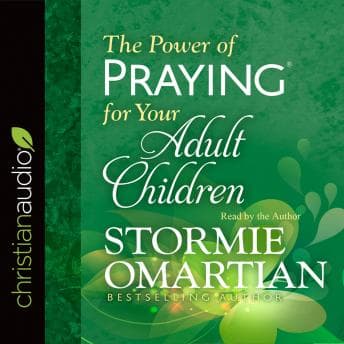

"I have learned numerous things about God's power but never experienced such things until I began praying."
That line hit me somewhere around hour two, walking the lakefront with Denise on a Sunday morning while she listened to her own podcast about true crime. (She has questionable taste. I love her anyway.) Here I was, a man who teaches teenagers to find meaning in Faulkner's run-on sentences, getting unexpectedly emotional about a book on prayer.
Let me be honest with you. This isn't my usual territory. I gravitate toward Hemingway's sparse prose and Middlemarch's psychological complexity. But Denise has been worried about our son lately—he's 28, making choices we don't understand, and we've had more than a few "confrontational conversations" as Stormie would put it. When she suggested we listen to this together, I said yes because that's what 23 years of marriage teaches you.
When the Author Becomes the Narrator—And It Actually Works
Stormie Omartian reading her own work is a gamble. Authors narrating their own books can go spectacularly wrong—I've suffered through enough celebrity memoirs to know. But here's the thing: this woman has been married over 50 years, raised two children to adulthood, and you can hear that experience in her voice. There's no performance happening. She's not acting. She's just... talking to you. Like a friend who's been through it and came out the other side with something to say.
Her tone is warm without being saccharine. Encouraging without being naive. When she shares stories from other parents—and there are plenty scattered throughout—you believe she's actually listened to these people, actually cared about their struggles. At 3 hours and 30 minutes, it's compact enough to finish in a long weekend of grading papers at 11 PM. (Principal Martinez, I was definitely working on curriculum development. The audiobook was just background noise. Definitely.)
The Prayer Length Problem—Or Is It?
Now, I've read the complaints. Some listeners find the prayers too long, too repetitive. And I understand that criticism intellectually. If you're approaching this as a quick self-help fix, yes, you'll get impatient.
But here's what I kept thinking about: we don't complain that Faulkner's sentences are too long. We understand he's doing something with that length. The prose is meant to be savored. Stormie's prayers operate similarly—they're not meant to be rushed through. They're meant to be prayed, slowly, with intention. The repetition isn't laziness; it's liturgical. It's the same reason we read the same passages at church year after year.
That said, if you're the type who listens at 2x speed (my students, basically), this will feel interminable. I kept it at 1.0x because—and I'll die on this hill—the author chose those words. She chose that pacing. Who am I to speed past her intention?
What Stormie Gets Right About Letting Go
The book addresses something I didn't expect to need: the guilt. The constant, low-grade worry that you didn't do enough, that their struggles are somehow your fault, that you should be doing something even when they're grown adults making their own choices.
One listener put it perfectly: "making me feel less guilty and easing the burden of worrying about the choices that my adult children make." That's not a small thing. That's the whole thing, really.
Stormie covers the practical concerns—career choices, marriages, parenting skills, struggles with addiction—but the underlying message is about release. About trusting that your prayers matter even when you can't see results. About loving fiercely while also stepping back.
This reminds me of what Hemingway said about writing: you have to kill your darlings. Parenting adult children requires something similar. You have to let go of the version of them you imagined, the future you planned, and love the actual person standing in front of you.
Who This Is For (And Who Should Keep Walking)
If you're a person of faith with adult children who worry you—and let's be honest, adult children worry all of us at some point—this is worth your time. If you're looking for academic theology or rigorous scriptural exegesis, look elsewhere. This is practical, devotional, and deeply personal.
If prayer feels like an abstract concept you've never quite connected with, Stormie's approach might actually help. That same practical, no-nonsense style is what made Girl, Wash Your Face connect with so many people, even if I found it a bit too formulaic for my taste. She's concrete. Specific. She gives you words when you don't have your own.
But if you want literary complexity or narrative arc, if you need plot and character development, this isn't that book. It's a tool. A useful one. Skip it if you're not a person of faith or if devotional content makes you restless—there's no secular angle here.
The Kind of Book You Talk About Afterward
I finished this on a Tuesday, grading sophomore essays on The Great Gatsby while Stormie prayed about adult children finding their purpose. The irony wasn't lost on me—here I am, teaching teenagers about Fitzgerald's obsession with unreachable dreams, while listening to a book about releasing your own dreams for your children.
Denise and I talked about it afterward. Really talked. The kind of conversation we hadn't had in months about our son. That alone made it worth the three and a half hours.
My students would probably hate this. I didn't. And that's enough.