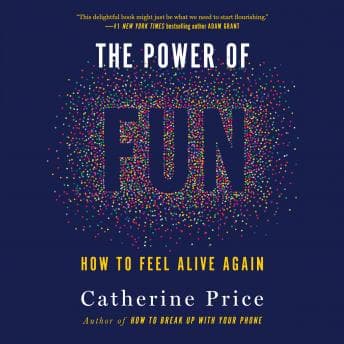

Catherine Price wrote a self-help book about fun, and I have feelings about it.
I was halfway through making a biryani — the real kind, with the dum and the layering and the whole production that takes three hours minimum — when Price started laying out her central framework. True Fun, she argues, is the intersection of playfulness, connection, and flow. And I stopped stirring the onions because, honestly? That's a pretty solid psychological model. It maps loosely onto self-determination theory (autonomy, competence, relatedness), and the fact that she's packaging decades of research into something this digestible is... not nothing.
But here's where my brain split in two.
The Framework Is Smart. The Repetition Is Not.
Price's core argument — that we've replaced genuine fun with what she calls "Fake Fun" (doomscrolling, binge-watching, the kind of phone usage that makes you feel worse afterward) — is genuinely useful. The research actually shows that people consistently mispredict what will make them happy, and Price does a good job connecting that hedonic forecasting error to our screen habits without being preachy about it. She's building on her previous book, How to Break Up with Your Phone, and you can feel the continuity. Same energy, broader scope.
The practical tools are where this book earns its keep. The "fun audit" — where you track moments of genuine fun over several weeks to identify your personal fun factors — is the kind of structured self-reflection exercise I'd actually assign to an undergrad psych class. The "fun times journal" is less groundbreaking but still useful as a behavioral tracking tool. Price understands that insight without action is just... therapy without the homework.
But — and this is a significant but — the book could've been 5 hours instead of 9. By hour 6, I found myself asking: why does Price keep restating the same thesis with slightly different framing? The distinction between True Fun and Fake Fun gets explained, re-explained, illustrated, re-illustrated, and then explained one more time for good measure. I get it. I got it by hour 3. The protagonist of this book (and yes, in self-help, the author IS the protagonist) exhibits classic overexplaining — the kind you see when someone is deeply passionate but doesn't trust their audience to have absorbed the point. My therapist would have thoughts about that impulse.
Price Reading Price: The Author-Narrator Question
So here's the thing about author-narrated self-help: it either works beautifully because you're hearing the ideas in the voice they were born in, or it falls flat because not every writer is a performer. Price lands somewhere in the warm middle. Her voice is clear, personable, genuinely approachable — she sounds like someone you'd want to sit next to at a dinner party. There's an ease to her delivery that makes the research sections feel conversational rather than lecture-y.
But she's not a trained narrator, and you can tell. The emotional range is narrow. When she's describing moments of genuine fun from her own life, she sounds pleasant but not transported. Compare this to, say, Brené Brown narrating her own work — Brown has this raw, cracked-open quality that makes you lean in. Price is warmer than a text-to-speech engine but cooler than someone telling you their best story over wine. It's fine. It's not electric.
The audio production is clean and straightforward. No music, no sound effects, no gimmicks. Which is appropriate — this isn't that kind of book.
Who This Is Actually For (And Who Should Run)
This is a fascinating case study in a particular kind of self-help reader: the person who suspects their life has become a series of obligations punctuated by scrolling, and who needs someone to give them permission — and a framework — to prioritize joy. If that's you, this book will feel like a relief. Price is essentially saying: fun isn't frivolous, it's a psychological need. And she's right. The same thread runs through Stress Relief Meditations — that reframing rest and pleasure as legitimate needs, not indulgences, is doing real psychological work even when the packaging looks soft.
But if you're already well-versed in positive psychology, flow state research (Csikszentmihalyi's work), or behavioral design — you'll find yourself nodding along without learning much new. The ideas are solid but not original. Price is a skilled synthesizer, not a pioneer.
Skip if: you have a low tolerance for repetition, or if you're the kind of person (like me) who gets irritated when a book takes 9 hours to deliver what could've been a tight 5-hour listen.
Listen if: you need the gentle, extended version. Sometimes repetition IS the point — it's how behavioral change sticks. And Price knows that.
My Clinical Notes
I finished this book, washed the biryani pot, and immediately did something I haven't done in weeks — called a friend just to talk. Not about anything. Just to talk. So either Price's framework works, or the biryani put me in a good mood. Possibly both. I'll give her the partial credit.