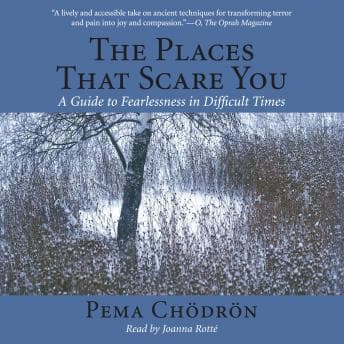

I picked this up during a particularly anxious stretch of dissertation revisions - you know, the kind where you're questioning every life choice that led you to academia. My therapist had been gently suggesting I try something "grounding," and honestly, I'd been avoiding Buddhist philosophy because I assumed it would feel too... soft? Too woo-woo for my research-oriented brain.
I was wrong. Spectacularly wrong.
The Psychology Behind the Teachings
Here's the thing about Pema Chödrön that I wasn't expecting: she's essentially doing clinical psychology without the jargon. The protagonist of this book - and yes, I'm treating fear itself as a character because that's what I do - exhibits classic avoidance patterns that any CBT practitioner would recognize. But instead of worksheets and behavioral experiments, Chödrön offers something older. Something that, the research actually shows, works on the same neural pathways we target in exposure therapy.
She talks about "shenpa" - this Tibetan concept for the hook, the urge, that moment before we spiral into our habitual patterns. I found myself asking: why does this simple reframe feel so powerful? Because she's naming the gap between stimulus and response. That's Viktor Frankl territory. That's the foundation of every mindfulness-based intervention we use in clinical settings. I found a similar grounding effect in Power of Now: A Guide to Spiritual Enlightenment, though Tolle approaches presence from a different angle.
What makes this audiobook compelling is that Chödrön doesn't pretend any of this is easy. She's refreshingly honest about how we resist our own growth, how we use anger and fear as armor. My therapist would have thoughts about this character - the fearful self Chödrön describes - and they'd probably be: "This is everyone. This is the human condition."
Joanna Rotte Gets It
The narration here is doing exactly what it needs to do. Joanna Rotte has this warm, unhurried quality that matches the material perfectly. I listened during my morning jogs through Cambridge (yes, I jog and contemplate Buddhist philosophy, don't @ me), and her pacing let me actually absorb the concepts instead of just hearing words.
She doesn't dramatize. She doesn't perform. She reads like someone sitting across from you, sharing something important but not trying to convince you of anything. For spiritual content, this is exactly right. A more theatrical narrator would've undermined the whole thing.
I couldn't find much about Rotte's other work online, but based on this performance, she understands that the teachings need space. The production is clean - no weird audio artifacts, no jarring transitions. Just her voice and these ideas.
Where It Gets Dense
Look, I'm not going to pretend this is light listening. There were moments - particularly when Chödrön gets into specific meditation practices - where I had to rewind. Not because Rotte wasn't clear, but because the concepts themselves require sitting with. This isn't a book you half-listen to while meal-prepping. (I tried. It doesn't work.)
At 4 hours and 28 minutes, it's short enough to revisit, which honestly feels intentional. This is a fascinating case study in how spiritual teachings can be structured for modern attention spans without being dumbed down. Chödrön respects your intelligence while acknowledging that fear is, well, scary.
Some listeners might find the approach too philosophical, not enough "here are your five steps to fearlessness." But that's precisely what I appreciated. Chödrön knows that fear doesn't respond to checklists. It responds to practice, to patience, to the slow work of staying present when everything in you wants to run.
Who This Is (and Isn't) For
This is for anyone who's ever noticed their own patterns of avoidance and wondered if there's another way. If you've done any therapy work around anxiety, this will feel like a companion piece - same destination, different map. If you're new to Buddhist philosophy, Chödrön is accessible without being simplistic.
Skip it if you want quick fixes. Skip it if meditative pacing makes you restless. (No judgment - different brains need different things.)
The Dissertation Defense I Didn't Expect
For me, this became one of those audiobooks I'll return to. Not because I've mastered anything it teaches - I definitely haven't - but because Chödrön offers something rare: permission to be afraid and move forward anyway. The places that scare us, she suggests, are exactly where we need to go.
My therapist would approve.