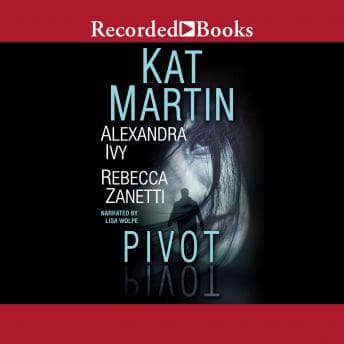

"Meri is keeping a dangerous secret—and Ian is in danger of losing his heart."
That line from the description pretty much tells you exactly what kind of book this is. And look, I knew what I was getting into. Three novellas, three foster sisters, three ex-boyfriends-turned-protectors, three flavors of romantic suspense. This is not Middlemarch. (For the record, nothing is Middlemarch. I was listening to Middlemarch during a budget meeting when I should've been paying attention, and I regret nothing.)
But here's the thing—I picked up Pivot during one of those late Sunday afternoons where Denise and I were doing separate lakefront walks because she wanted her true crime podcast and I wanted... well, I didn't know what I wanted. Something lighter. Something where the stakes are high but the resolution is guaranteed. Sometimes a man who spends his weeks dissecting the ambiguity of The Great Gatsby with teenagers who'd rather be on TikTok just needs a book where the bad guys lose and people kiss at the end.
Three Stories, Three Authors, One Narrator Holding It All Together
The anthology format is tricky. I've taught enough short story collections to know that unevenness is the rule, not the exception. Pivot doesn't escape this. Alexandra Ivy's opener with Meri—the young mother fleeing L.A. with her daughter, landing on ex-cop Ian Brodie's farm—has that classic setup energy. It's doing the heavy lifting of establishing the foster-sister connection, which means it sometimes feels like it's laying pipe for the other two stories rather than living fully in its own. The farmhouse setting gives it a different texture than the later urban stories, but some of Meri's decisions had me doing that teacher thing where I write "motivation?" in the margins.
Kat Martin's middle story, with Melanie ramming her car into kidnappers and then running smack into her ex-detective, is the most conventionally thriller-paced of the three. Dirty cops, drug trafficking, a conspiracy thread. It moves. But it also felt the most compressed—like a full novel squeezed into novella length, where character beats get sacrificed for plot momentum.
Rebecca Zanetti's closer with Michelle and ex-marine Evan Boldon? That's the one that earns the real estate. The dynamic of a mentally unstable mother on a blackmail spree while Michelle is trying to hold her life together—there's actual emotional architecture there. The push-pull between Michelle's independence and Evan's "I'm not asking permission" protector mode could've been insufferable, but Zanetti writes it with enough self-awareness that it lands somewhere between frustrating and genuinely affecting. My students would hate this. I kind of loved it.
What works best about the collection is actually the connective tissue. The three foster sisters share information across their stories, and by the third novella, you feel the weight of that shared history. The author is really saying something—three separate authors, actually—about chosen family and how women who raised themselves don't easily let people in. It's not subtle. But it doesn't need to be.
Lisa Wolpe and the Challenge of a Three-Headed Book
Here's where I have to be honest about the limitations of what I can tell you. Lisa Wolpe is a solo narrator handling three different novellas by three different authors with three different tonal registers. That's a lot to ask of anyone. The narration is competent—she keeps the stories moving, and I never lost track of who was speaking, which in an anthology with this many characters is not nothing.
But I didn't get that electric feeling I get when a narrator truly inhabits a character. The prose deserves to be savored, sure, but these novellas are written at thriller pace, and the narration matches that energy without adding much interpretive texture. The narrator understands that pause is punctuation—but she doesn't always use it. The transitions between the three distinct author voices could've been an opportunity for subtle shifts in cadence, and I wanted more of that differentiation than I got.
I listened at my usual 1.0x. For this one, 1.25x wouldn't hurt if you're a faster listener. (My students just gasped. Yes, I said it.)
Who Gets the Seat, Who Gets the Door
If you loved the connected-novella format of something like Nora Roberts' trilogies and want your romantic suspense in concentrated doses, this is its spiritual successor—lighter, faster, with that satisfaction of seeing how the threads weave between stories. It's a solid weekend listen.
If you need deep character development and can't stand the ex-boyfriend-as-rescuer trope repeated three times in nine hours, you'll bounce off this hard. The repetition is a feature if you're into it, a bug if you're not.
Worth pausing the faculty meeting for? Probably not. Worth a Sunday lakefront walk when you need your brain to rest? Absolutely. Troubles in Paradise scratched a similar itch for me—connected stories, guaranteed resolutions, the kind of thing that asks nothing of you except to show up and let it happen.