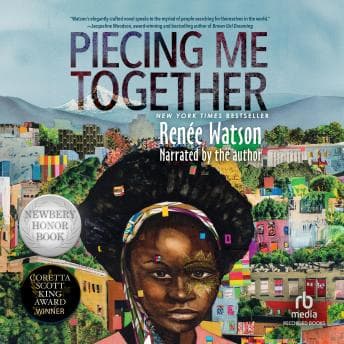

I was supposed to be debugging my procedural generation algorithm. That was the plan. But I'd just finished the Stormlight Archive reread (don't judge me, I needed it), and my Audible library suggested this as something completely different. Five hours later, my code was still broken, but I'd listened to the entire thing while stress-eating Doritos at 2 AM.
Look, I know what you're thinking. "Tom, you're a fantasy guy. What are you doing reviewing contemporary YA?" Fair question. But here's the thing—Renée Watson builds Jade's world with the same meticulous care that Sanderson builds his magic systems. Different materials, same craftsmanship.
The World-Building You Didn't Know You Needed
Jade's Portland isn't some generic "urban setting." Watson constructs it with the precision of a dungeon master laying out a campaign map. There's the bus route that literally divides her life—the ride from her neighborhood to St. Francis, the private school where she's simultaneously invisible and hyper-visible. There's the geography of opportunity and its absence. The way Watson describes Jade's home versus the spaces she's supposed to aspire to? That's environmental storytelling. My D&D group would appreciate how the setting does half the character work.
That same careful attention to how physical spaces shape identity shows up in Witch of Blackbird Pond, where Kit's navigation between Puritan Connecticut and her Barbados upbringing creates similar tension.
And here's something I genuinely loved: Watson introduces each chapter with Spanish vocabulary that Jade's learning, reinforcing her character's hunger for knowledge while also showing how she's piecing together her identity. It's a small structural choice that pays off repeatedly. Like a good game mechanic—simple to understand, complex in execution.
When the Author IS the Narrator
Watson narrating her own work is... okay, I need to compare this to something. You know how some fantasy authors do their own audiobooks and it's a disaster because they can't do voices? (We've all suffered through at least one.) This is the opposite problem—in the best way. Watson doesn't try to perform the book. She delivers it. Her voice carries this quiet determination that IS Jade.
The emotional beats land because Watson knows exactly where they should hit. There's an honesty in her delivery that a hired narrator might have polished away. When Jade's frustration boils over about being treated as an "at-risk" girl who needs fixing? You feel the author's own lived experience bleeding through. It's not theatrical. It's real.
That said—and I say this with love—if you're coming from audiobooks with distinct character voices, you'll need to adjust. Watson doesn't do wildly different voices for each character. Jade's mom, her mentor Maxine, her best friend—they're differentiated through dialogue and context more than vocal performance. For a 5.5-hour listen, this works fine. For a 40-hour epic? Different story.
The Progression System (Yes, I'm Calling It That)
Jade's arc is basically character progression without the stat blocks. She starts at Level 1: accepting every opportunity because that's what you're supposed to do. By the end, she's leveled up to understanding that she gets to define what opportunity means for HER. The Women to Women mentorship program isn't a villain—it's more like a well-meaning NPC who keeps giving you quests you didn't ask for.
The collage art that Jade creates becomes her way of processing everything. Watson describes these pieces with enough detail that I could picture them, and honestly? They'd make killer campaign inspiration. Girl with the Make-Believe Husband uses a similar technique with Cecilia's letters—creating meaning through assembled pieces when direct expression isn't possible. Mixed media, found objects, images that tell stories the artist couldn't speak aloud. That's the kind of worldbuilding detail that separates good books from great ones.
Content Check: Not a Light Listen
I need to flag this because it matters: there's racial profiling, references to police brutality, and real-world social issues woven throughout. This isn't trauma porn—Watson handles it with care—but it's also not escapism. If you're looking for something to zone out to during your commute, this ain't it. This is a focused-listening book. Headphones on, world off.
Who's Rolling Initiative on This One
If you've got a teen in your life who needs to see themselves in fiction—especially Black girls navigating predominantly white spaces—hand them this audiobook immediately. If you're an adult who wants to understand experiences different from your own without being lectured at, this delivers. If you're a fantasy nerd like me who appreciates careful world-building regardless of genre, you'll find more craft here than in half the epic fantasies I've slogged through.
Skip if you need distinct character voices to follow dialogue, or if you're specifically looking for escapist fiction. This book wants you present.
Worth Abandoning My Thesis For
I started this at midnight and finished before my 8 AM class. (I did not make my 8 AM class.) Watson's author-narration adds something a professional narrator couldn't replicate—authenticity that cuts through any performance polish. The pacing is tight, the emotional beats are earned, and Jade's journey from accepting other people's definitions to creating her own? That's a satisfying character arc.
The magic system is *chef's kiss*—if the magic system is learning to see yourself clearly in a world that keeps trying to tell you who you are.
Dr. Patel is still concerned about my progress. I am still not. Some books are worth the delay.