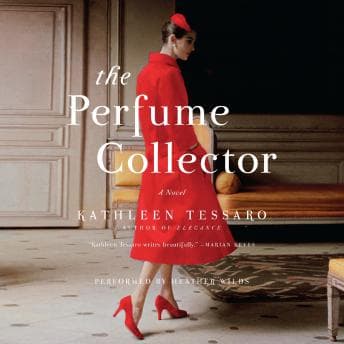

Denise and I were walking the lakefront last Saturday - one of those early mornings where the fog hasn't burned off Lake Michigan yet and everything smells like cold water and wet stone. She had her own podcast going, I had my earbuds in, and somewhere around hour two of The Perfume Collector, Tessaro started describing the base notes of a perfume called Ticket Russe - leather, smoke, the warmth of a stranger's coat in a train compartment - and I swear I could smell it. I stopped walking. Denise thought I'd twisted my ankle. No, I told her. I'm just standing in 1920s Paris right now. Give me a minute.
That's the trick of this book. It gets into your senses in a way most historical fiction doesn't even attempt.
When Scent Becomes Character
Here's what Kathleen Tessaro does that I genuinely haven't encountered in this particular way before: she uses perfume as narrative architecture. The three fragrances at the center of the story - each one created to capture a chapter of Eva d'Orsey's life - aren't just plot devices. They're the structure. Each scent corresponds to a different era, a different city, a different version of Eva. And Tessaro writes about perfume composition the way a music critic writes about symphonies - top notes, heart notes, base notes, the way a fragrance evolves on skin over hours. It reminded me of what Hemingway said about writing one true sentence and then writing the next true sentence after that. Tessaro found her true sentences in the language of perfumery, and she commits to them fully.
The dual timeline - Grace Monroe's stifled 1950s London marriage alternating with Eva d'Orsey's wild, sometimes brutal journey from 1920s New York through Monte Carlo and Paris - is a structure we've seen before. The ideological machinery in Darkness at Noon works similarly - a familiar structure made devastating by what the author threads through its center. But the perfume thread holds it together in a way that feels earned rather than mechanical. Grace is the kind of protagonist who would bore my students to tears at first. She's passive. She's polite. She wears the right clothes and says the right things and has absolutely no idea who she is. But that's the point. The whole novel is about the distance between the woman you perform and the woman you actually are. If you loved The Age of Innocence, this is its spiritual successor - except Wharton's characters are trapped by society, and Grace has to realize she's been trapping herself.
Eva, by contrast, is feral. Born into nothing, she claws her way through a world that wants to use her, and she lets herself be used - but on her own terms. The relationship between Eva and the perfumer André - muse and artist, obsession and creation - is where Tessaro's writing gets genuinely uncomfortable. Not romantic-uncomfortable. More like watching someone hand over pieces of their identity to be bottled and sold. The prose deserves to be savored in those sections. There's a coldness underneath the beauty that I kept turning over in my mind.
Heather Wilds Knows What Restraint Sounds Like
I listened at 1.0x, obviously, because the author chose those words. And Heather Wilds' narration rewarded that choice. She's not flashy. She doesn't do dramatic vocal gymnastics between characters. What she does is modulate temperature. Grace's chapters feel cooler, more measured, slightly held-back - like a woman who's been told her whole life to keep her voice down. Eva's sections run warmer, breathier, with a slight edge that suggests danger even in quiet moments. It's subtle work. The kind of performance where you don't notice the craft until you stop and think about why you feel differently in each timeline.
One listener I came across called her narration "outclassing every other version" of this book, and while I can't compare directly, I believe it. There's a bittersweet quality to Wilds' delivery - she understands that this is ultimately a sad story wearing beautiful clothes. The narrator understands that pause is punctuation, and Wilds uses silence in the Eva sections the way Tessaro uses scent: sparingly, precisely, to devastating effect.
My one hesitation: twelve hours is a commitment, and the middle third - particularly some of the Monte Carlo passages - meanders. Tessaro occasionally gets so absorbed in period atmosphere that the plot stalls. I was grading sophomore essays during those stretches, and I won't pretend I didn't drift. But the final third pulled me back hard. The reveal of Eva's connection to Grace isn't exactly shocking if you've read enough dual-timeline fiction, but the emotional weight of it still landed. Because by then, you know these women. You've been breathing their air.
Who Gets the Assignment (And Who Gets a Pass)
This is for readers who love historical fiction that prioritizes atmosphere over action. If you want plot twists every chapter, look elsewhere. But if you're the kind of listener who wants to feel like you've lived inside another era - who wants to know what Paris smelled like in 1927 - this is your book. Fans of The Paris Wife, The Muse, or anyone who's ever stood too long at a perfume counter trying to name what a scent reminds them of. My students would hate this. I love it.
Skip it if slow-burn character studies make you impatient. And if you need a likable protagonist from page one, Grace will frustrate you before she rewards you.
Worth Pausing the Faculty Meeting For
This isn't a perfect novel. The pacing wobbles, the dual-timeline structure does exactly what you expect it to, and Grace's husband is so thinly drawn he's practically a cardboard cutout labeled "Bad Match." But the perfume writing is genuinely special - the kind of sensory specificity that makes an audiobook feel almost synesthetic. And Wilds' narration carries it with a quiet authority that never oversells the emotion. I finished it on a Sunday evening walk, fog rolling in again, and I just stood there for a minute. Breathing in.