
"The city pressed in around him, oozing like a wound."
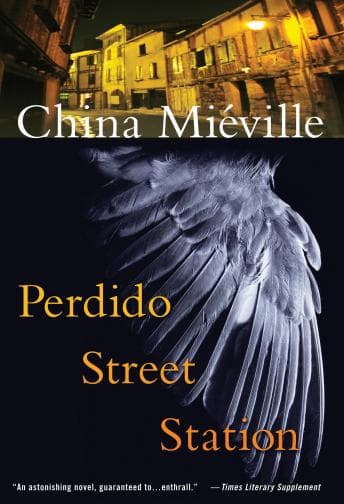
Somewhere around hour three, sitting in my kitchen at midnight eating cold leftover pad thai because I couldn't sleep after an on-call page that turned out to be a false alarm, I realized I'd stopped chewing. Just standing there with a fork in my hand, completely absorbed in China Miéville describing the industrial rot of New Crobuzon like he's writing love poetry to a sewer.
TL;DR: Worth your commute — but barely, and with serious caveats about the narration and the commitment level this demands.
This Is Basically a Lovecraftian Distributed System With No Documentation
Let me explain what this book actually is, because the description undersells the weirdness. New Crobuzon isn't just a fantasy city. It's a living, suppurating organism where bug-headed women (khepri) sculpt art from colored spit, bird-people (garuda) have their wings clipped as criminal punishment, and there's a literal government department for managing the dimensions of hell. Miéville doesn't worldbuild — he worldvomits. Every paragraph adds three new species, four new districts, and a political ideology you've never heard of.
And I mean that as both praise and warning.
The core plot: Isaac, a rogue scientist, accidentally unleashes dream-eating slake-moths on the city while trying to help a de-winged garuda fly again. Simple enough. But the book takes about 10 hours to get there, and those 10 hours are dense. We're talking pages-long descriptions of architecture, political systems, xenian biology, drug culture. If you're a worldbuilding junkie — and I am — it's extraordinary. If you want things to happen before lunch, you're going to have a bad time.
The science actually holds up — well, the internal logic does. Miéville's concept of "crisis energy" as a unified field theory for magic and science is the kind of thing that makes my distributed-systems brain light up. It's like he designed a consistent API for the supernatural and then stress-tested it.
John Lee's Voice Is the Architecture; His Characters Are the Plumbing
Here's where it gets complicated. John Lee's base narration voice is perfect for this book. Rich, unhurried, almost geological — exactly what you need for a 24-hour tour through a city that feels like Victorian London got crossbred with Hieronymus Bosch. When he's describing New Crobuzon's skyline or the Ribs (massive bones of some ancient creature arching over an entire district), you can practically smell the sulfur and engine grease.
But then the Ambassador of Hell opens his mouth.
I don't know what John Lee was going for with that voice — something between a cartoon villain and a malfunctioning text-to-speech engine? — but it yanked me out of the scene every single time. Same with the Construct Council's avatar, which gets this wavering, whiny quality that made me want to skip forward. In a book where you're spending 24 hours with these characters, annoying voices aren't a minor issue.
The fight scenes are the other weak spot. There's a genuinely horrifying sequence between the Handlingers (parasitic hand-creatures that control host bodies — yes, really) and the slake-moths, and it should be terrifying. But Lee repeats these elongated screams and doesn't quite nail the pacing of the action. It's like watching a horror movie where the sound design is slightly off — the content is scary, but the delivery mutes the impact.
When he's good, though, he's really good. His Isaac is gruff and endearing. His Lin (Isaac's khepri artist girlfriend) has this quiet precision that works. And his general narration of Miéville's prose — which is baroque and dense and sometimes absurdly beautiful — lands about 85% of the time.
Who Should Brave New Crobuzon (And Who Should Stay Home)
Perfect for: dedicated listening sessions, roadtrips with a patient co-pilot. Skip for: 6 AM commutes when you're barely conscious. This is NOT a 1.5x book. I tried. The prose is too dense and Miéville's vocabulary is too aggressive — I actually dropped to 1.25x for the first time in months. You need to be awake and present.
If you loved Jeff VanderMeer's Annihilation or Gormenghast, this is your next obsession. If you bounced off Tolkien for being too descriptive — buddy, you're not ready. I'll say this though — I gave Into the Forest a shot on a similar "dense and demanding" recommendation, and while the world there is quieter and more interior than New Crobuzon, it has that same quality of pulling you so fully into its logic that resurfacing feels slightly disorienting.
The ROI on this audiobook is high but front-loaded with effort. Think of it like learning a new codebase: the first 8-10 hours are orientation, and then suddenly you know the city and you're sprinting through the back half. The ending is... divisive. I found it earned, but I can see why people feel cheated after 24 hours of investment.
Deploy to Production? With Caveats.
I finished this across two weeks of commutes plus three late-night sessions, and I'm genuinely glad I did. Miéville built something I've never encountered in fantasy — a city that feels as real and messy and systemically broken as an actual city. The narrator mostly serves it well, with some frustrating exceptions. It's a 24-hour commitment that demands your full attention, rewards patience, and occasionally makes you stand in your kitchen at midnight forgetting to eat.
Not for everyone. But if it's for you, it's really for you.