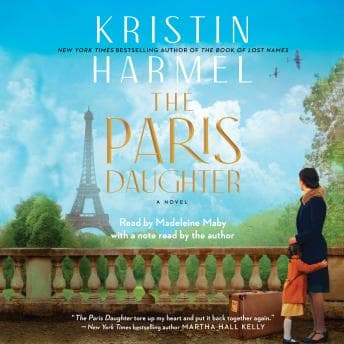

This book broke me on a Tuesday afternoon while I was designing wedding invitations for a couple in Dripping Springs.
I had to stop working. Like, fully close Illustrator, push my laptop back, and just sit there with my headphones on while Madeleine Maby described Juliette standing in the rubble of her bookshop — the Librairie des Rêves, this little dream of a place she'd built — and I was gone. Frida jumped on my lap like she knew. Diego watched from the desk with his usual indifference. But I was a mess.
Two Mothers, One Impossible Promise
Here's the thing about The Paris Daughter that got under my skin in a way I wasn't expecting: it's not really a war book. I mean, yes, it's set during the Nazi occupation of Paris, and yes, there are bombs and loss and all the weight of WWII. But the engine of this story is something much more specific — it's about what happens when you hand your child to your friend and say keep her safe, and then the world falls apart anyway. Elise trusts Juliette with her daughter. And Juliette tries. God, she tries.
What Kristin Harmel does so well here is let the guilt live in both women simultaneously. Elise's guilt for leaving. Juliette's guilt for what happens after. Neither woman is wrong, and neither woman is okay, and that tension — that quiet, suffocating tension of two people who love the same child and can't find each other — that's where the emotional gut punch lives. It's not in the big war set pieces. It's in the silence after.
I kept thinking about my abuela. How she crossed a border with my mom as a baby, trusting people she barely knew at certain points along the way. How she never talked about the fear of it, only the relief of the after. Abuela would have sobbed through this one and then made me drive her to church.
Maby's Voice Is a Slow River — Beautiful, Sometimes Too Slow
Madeleine Maby has this warm, steady delivery that wraps around you like a blanket. Her French pronunciation is genuinely lovely — Librairie des Rêves rolls off her tongue like she grew up in the Marais, and the character names never feel clunky or Americanized. That matters in a book like this. Paris needs to feel like Paris, not a set.
But — and this is where I have to be honest — the pacing dragged in places. Somewhere around the middle stretch, when the narrative bounces between Elise's search and Juliette's grief, Maby's measured delivery made sections feel like wading through honey. Pretty honey. But still slow. I listened at my usual 1.0x because I'm stubborn about savoring, and there were moments I thought about bumping it up to 1.15x. I didn't. But I thought about it. That's significant for me.
She doesn't do wildly distinct character voices — it's more of a tonal shift, warmer for Juliette's chapters, slightly more desperate in Elise's — and honestly, for a dual-timeline book with two mothers as leads, I wanted a little more differentiation. When both women are grieving (which is... a lot of the book), their sections can blur together sonically.
There are subtle sound cues in the production — rustling, distant sirens during the war chapters — that add atmosphere without being distracting. Nice touch. Didn't pull me out of the story.
The Predictability Problem (And Why I Didn't Care)
Look, I'll say what other reviewers are saying: you can see some of the plot turns coming from a distance. The structure telegraphs certain revelations, and if you've read Harmel's other work — especially The Book of Lost Names — you'll recognize her rhythm. The final reunion arc unfolds pretty much how you'd expect.
But here's my counter-argument: I knew exactly where Beach Read was going too, and I still cried four separate times. Kerry Tucker Learns to Live pulled the same trick on me — I clocked the ending from chapter three and cried anyway, which tells you something about what earned emotion can do even when the map is visible. Predictability isn't a flaw when the emotional execution is this specific. The scene where Juliette realizes what she's lost — not just the building, not just the books, but the promise she made — I knew grief was coming and it still wrecked me. Because Harmel earns it with the small details. The way Juliette memorizes the pattern of a child's breathing. The paper stars Elise folds to keep herself sane. That's not plot mechanics. That's emotional architecture.
Crying sessions for this one: three. (The spreadsheet has been updated.)
Who Needs This Book (And Who Should Scroll Past)
If you're a mother, or you were raised by someone who sacrificed something enormous for you, this book will find the tender spot and press. Hard. If you love WWII historical fiction but want it filtered through intimate relationships rather than battlefield scope, this is your rainy Sunday book.
If slow pacing makes you restless, or if you need plot twists you genuinely can't predict, you might find yourself frustrated. And if you need distinct narrator voices to track multiple characters — maybe read the print version instead.
But if you're like me, and you pick up books hoping they'll make you feel something real? This one delivers.
Abuela Would Have Made Me Replay the Ending
Three crying sessions. Two cats who are now concerned about me. One book that reminded me why I keep doing this — listening for hours while I work, letting stories crawl inside me and rearrange things. The Paris Daughter isn't perfect. The pacing wobbles, the structure is familiar, and Maby's narration could use a little more fire in places. But the emotional core — two women, one child, an impossible war — that part is absolutely real. My heart. MY HEART.