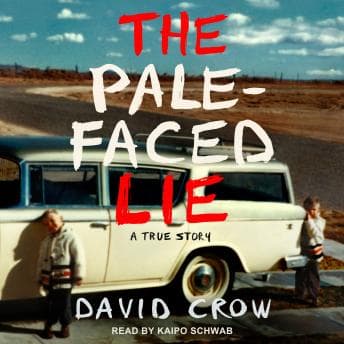

I have a complaint. A serious one. I had a deadline — a full rebrand for a yoga studio, clean lines, calming energy, the whole zen thing — and instead of focusing, I spent three straight design sessions white-knuckling my way through David Crow's childhood while Frida stared at me from the desk like, "Why are you crying over a man named Thurston?" Because THURSTON CROW, that's why. This man is genuinely one of the most terrifying fathers I've ever encountered in a memoir, and I've listened to a lot of memoirs about terrible parents. But Thurston? Thurston is something else entirely. The closest I've come to a father figure this deeply unsettling in any book was actually in the very different world of Rebecca of Sunnybrook Farm — though that one leans hard into the adults who save a child rather than the ones who destroy her, which made the contrast hit me in a completely different way.
Here's what got me: the book opens on the Navajo Reservation, and little David worships his dad. He's this tall, charismatic Cherokee guy spinning war stories, and you can feel it — that desperate kid-love where you'd believe anything because the alternative is too ugly. And then the floor drops. Slowly at first, then all at once. The shift from hero worship to survival mode hit me somewhere around hour three, and I had to pause and just… sit with it. Diego jumped into my lap like he knew.
The Kind of Father Who Makes You Check the Locks
What makes this memoir land differently than your average "I survived my childhood" book is how methodical Thurston's cruelty is. This isn't a drunk who loses his temper — this is a man with a genius IQ who uses beatings to recruit his own son into criminal activity. There's a calculated quality to it that Crow describes without melodrama, which somehow makes it worse. He writes about the violence the way you'd describe weather. Matter-of-fact. That happened. Then this happened. And you're sitting there with your jaw on the floor while he just... keeps going.
The detail about San Quentin — Thurston bragging that his three years there were the easiest time of his life — that sentence broke something in me. Because what kind of person finds prison relaxing? And what does that say about the home he created for his children? Crow doesn't spell it out for you. He trusts you to do the math. And the math is devastating.
Kaipo Schwab and the Art of Emotional Flatness (Complimentary)
Okay so here's where I need to talk about Schwab's narration, because it does something I've rarely heard done well: he matches Crow's emotional detachment. When David describes abuse, Schwab doesn't go full dramatic — he pulls back. His voice goes quiet and even, the way people actually sound when they're recounting trauma they've processed but not fully healed from. It's not flat like bad-narrator flat. It's flat like dissociation. Like the kid who learned early that showing pain gets you hit harder.
His dialect work is solid too — there's an authenticity to how he handles the reservation setting, the way certain characters speak, that feels lived-in rather than performed. You can hear the difference between the world David grew up in and the world he eventually claws his way into. But the real magic is in the restraint. When the emotional peaks hit — and they do, hard — Schwab lets the words carry the weight instead of his voice. At 1.0x speed (obviously), every pause lands.
When Survival Is the Whole Plot
I'll be honest — around hour seven, I felt exhausted. Not bored, but genuinely worn down by the relentlessness of it. There's no safe harbor in this story for a long time. David's mother is too mentally ill to protect her children, and the stepmother turns out to be equally vicious, which — I actually gasped out loud at my desk when that became clear. You keep waiting for the rescue and it just doesn't come.
But that's also what makes the second half so powerful. When David starts fighting his way toward something better — college, a career, a life that isn't controlled by his father — every small victory feels enormous. And that final twenty-four-hour showdown with Thurston? The buildup is almost unbearable. You're spending twelve hours learning exactly how dangerous and brilliant this man is, and then David has to outsmart him with lives on the line. My heart. MY HEART.
I ugly-cried twice. Once around the middle when David talks about the people who helped him — those few "angels" who saw a kid drowning and reached in — and once near the end. The second time I had to stop working entirely and just lie on my floor with my cats.
Abuela would have hated this book, honestly. She would have clutched her rosary so hard the beads would've snapped. But she would have finished it. She always respected survival stories.
Who Needs to Hear This (and Who Should Brace Themselves)
If you listen to memoirs for the emotional gut-punch, this is your book. If you need to understand how cycles of abuse work — the manipulation, the loyalty that doesn't make sense from the outside — David Crow lays it bare without asking for pity. But please hear me: the content warnings are real. Violence, child abuse, psychological torture. This is not a background listen. This is a sit-down-and-pay-attention listen. If you're in a fragile place, maybe save it for when you're steadier.
This book felt like watching someone build a life out of wreckage with their bare hands. Bruised and bloody and still standing.