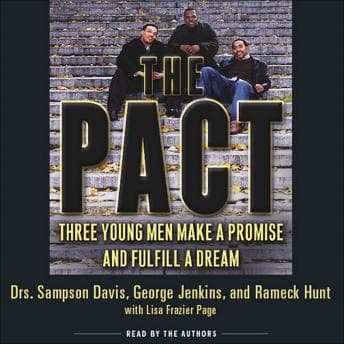
I was sitting in the break room at 4 AM, halfway through a granola bar and completely wrecked from a rough code earlier that shift, when George Jenkins started talking about watching his friend almost throw away everything they'd worked for. And I just... stopped chewing.
Look, I've been the person who almost didn't make it. First-generation college student, everyone telling me nursing school was too hard, too expensive, why not just get a job at the hospital cafeteria instead? So when these three guys from Newark - George, Sampson, and Rameck - made a pact to become doctors together, I felt that in my bones. This isn't some inspirational poster. This is survival strategy.
When the Authors Tell Their Own Story
Here's what makes this audiobook work: George Jenkins and Sampson Davis narrate it themselves. And honestly? You can hear everything in their voices. The pride. The pain. The moments where they're clearly still processing what they went through decades later.
The narration isn't polished in that Hollywood way. Sometimes their voices don't mesh perfectly when they're trading off sections. There's an occasional awkward transition. But I don't care. Because when Sampson talks about juvenile detention, or George describes watching friends get pulled into the drug trade, you're hearing the actual person who lived it. No actor could give you that.
They switch between perspectives throughout - each guy telling his own part of the story - and it's surprisingly easy to follow who's speaking. Their voices are distinct, their experiences different enough that you never lose track. George has this steady, almost professorial quality. Sampson brings more raw emotion. (Rameck doesn't narrate, which - I wonder about that, but the book doesn't address it.)
The Parts That Hit Different at 3 AM
As someone who's actually worked a code, who's seen young men come through the trauma bay with gunshot wounds, who's held the hands of mothers who lost their sons to the streets - this book is hard to listen to. Not because it's poorly done. Because it's real.
These three could have been any of the young men I've seen on the wrong side of a gurney. They talk about the pull of easy money, the friends who didn't make it, the constant pressure to give up on "unrealistic" dreams. And they're brutally honest about their own mistakes. Two of them did time in juvenile detention. They weren't angels who magically escaped their circumstances - they fought for it, failed, got back up, and kept fighting.
The medical school sections hit me particularly hard. The isolation of being the only Black students in their classes. The professors who doubted them. The financial stress. I know that feeling of walking into a room and knowing people are waiting for you to fail. My mom still has the newspaper clipping from when I passed my boards - she shows it to everyone at church. These guys' families probably have similar collections.
What This Book Gets Right (And What It Doesn't)
The friendship piece is the heart of it. They made a literal pact - we're all going to become doctors, and we're going to drag each other across the finish line if we have to. That's not how we usually talk about male friendship, especially among young Black men. The narrative we get is competition, violence, betrayal. Alexander Hamilton explores a different kind of brotherhood forged through revolution, but the same principle applies - men lifting each other up instead of tearing each other down. This is something else entirely.
Now, is the story sometimes predictable? Yeah. You know going in that they make it - that's the whole premise. And some sections feel a bit surface-level, like they're giving you the highlight reel rather than the full messy truth. I wanted more depth in places, more of the ugly moments, the times they almost gave up on each other.
But at under six hours, it's not trying to be an exhaustive memoir. It's trying to prove a point: that brotherhood can be a survival mechanism, that young men can hold each other accountable for their dreams instead of their destruction.
Who This Is For (And Who Should Skip It)
My mom would love this. She'd probably mail copies to all five of her kids with highlighted passages and sticky notes. (She still thinks I should've been a doctor, but Dr. Jenkins and Dr. Davis might finally convince her that nurses are pretty great too.)
If you work with young people, if you mentor, if you're a first-generation anything trying to make it, if you've ever been the person everyone expected to fail... this is your book. Perfect for that post-shift decompression when you need something real but ultimately hopeful. Skip it if you want deep literary analysis or a polished production - that's not what this is.
Clocking Out
Carlos asked why I was crying in the car after this one. I blamed allergies. He didn't believe me.








![Steve Jobs [unabridged audiobook] audiobook cover](/_next/image?url=https%3A%2F%2Fcovers.audiobooks.com%2Fimages%2Fcovers%2Ffull%2F9788499923406.jpg&w=1920&q=75)