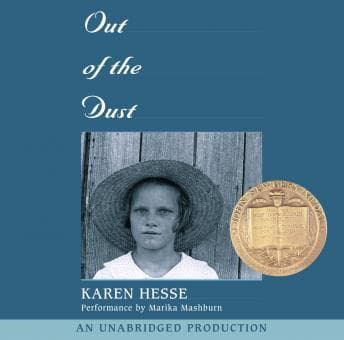

So here's the thing: everyone kept telling me this is a book you read, not listen to. That the free verse poetry demands your eyes on the page, that you need to see the white space, the line breaks, the way Hesse lets silence do the heavy lifting. And honestly? They're not entirely wrong. But they're not entirely right either.
I pulled this up on a Sunday morning when Kevin was still asleep and I was making coffee after a rough on-call weekend. Two hours and nine minutes. That's not even a full commute round trip. I figured worst case, I'd knock out a Newbery winner before noon and feel cultured.
What I didn't expect was to stand in my kitchen holding an empty mug for twenty minutes, not moving, just... listening.
Dust Bowl Poetry at 1.25x Hits Different
Let me be real about format. This is a novel written entirely in free verse poems. Each one is maybe 30 seconds to a minute of audio. Billie Jo's voice - a fourteen-year-old girl in 1930s Oklahoma watching her world literally blow away in dust storms - comes through in these spare, sharp fragments. Mashburn reads them with a Midwestern flatness that works because the emotion isn't in vocal pyrotechnics. It's in the pauses. The way she drops her register when Billie Jo talks about her burned hands, the ones that used to play piano, the ones that touched the burning kerosene that killed her mother.
Yeah. This is a kids' book. Sure.
The thing about listening vs. reading here is that you lose the visual spacing but you gain something else - rhythm. Hesse wrote these poems to be spoken. Lines like Billie Jo describing dust filling her nose, her ears, her food, her lungs - they hit harder when someone's actually breathing them at you. Mashburn's pacing is deliberate without being slow. She lets the poems land.
But - and this is where I get why people push the print version - some of the shorter poems feel like they blur together in audio. When you're reading, each poem sits on its own page. You absorb it, turn the page, reset. In audio, they flow into a continuous stream, and occasionally I'd lose track of where one ended and the next began. Not a dealbreaker, but worth knowing.
The Accidental Self-Help Book That Actually Earns It
I'm putting this in my "self-help that doesn't know it's self-help" category, and I mean that as the highest compliment. I've read a lot of self-help that recycles the same platitudes—Atomic Habits is a rare exception that actually delivers—yet this novel outdoes them all. Because every actual self-help book about resilience and healing could've just been this novel. The ROI on this audiobook is absurd - two hours for a genuinely honest exploration of grief, forgiveness, and the terrifying act of deciding to stay. It's the kind of profound look at suffering that I usually get from books like Man's Search for Ultimate Meaning, but here it's wrapped in a story so spare you could read it in a lunch break.
Billie Jo's father accidentally causes the fire that kills her pregnant mother. Billie Jo tries to help and destroys her own hands in the process. Her father retreats into silence. The dust keeps coming. And Billie Jo has to figure out whether to run - literally, she gets on a train heading west - or come back to a broken home in a broken landscape and try to rebuild.
What got me was the specificity of her grief. It's not abstract sadness. It's about not being able to play piano anymore. It's about the way her father stops looking at her because she reminds him of what he did. It's about apples. Her mother loved apples, planted apple trees in Oklahoma dust bowl country, which is either the most stubborn or the most hopeful thing I've ever heard.
(I may have thought about my own mom's garden back in Seattle. Irrelevant. Moving on.)
Mashburn vs. The Page
Mashburn sounds young enough to be Billie Jo without sounding like she's performing youth - no vocal fry, no exaggerated innocence. There's a roughness to her delivery that fits a girl who's been breathing dirt for years. She doesn't do character voices for the father or the other townspeople, which in a full-cast production would bother me, but here it works because this is Billie Jo's internal world. Everyone else is filtered through her perception.
The production is clean. No sound effects, no music, no dust storm ambiance (though honestly, that could've been cool). Just voice. For two hours, that's enough.
Narrator rating caveat: she's good. She's right for this. But I'm not going to tell you this is a Ray Porter-level performance where the narrator becomes the reason to choose audio. If you're specifically deciding between reading and listening, it's closer to a coin flip. I'd say listen first, then buy the print edition when you inevitably want to revisit it.
Perfect for: Quiet mornings, short flights. Skip for: Crowded trains at 6AM.
This is a strange rec from me because I usually optimize for commute-worthiness, and this one I'd actually say don't listen on your commute. It's too short and too quiet to compete with a packed Caltrain. Save it for a morning when you have two hours and nowhere to be. Let the silence between the poems breathe.
If you've got a teen who needs to read it for school, the audiobook is a solid companion - under two and a half hours means they can listen and then actually engage with the text. If you're an adult who dismissed this as a "kids' book," you're wrong, and I say that as someone who regularly reads 600-page hard sci-fi about distributed consciousness.
Sometimes the most efficient code is the shortest. Hesse wrote the leanest, most compressed novel about grief I've encountered, and Mashburn delivers it without wasting a single breath.
The Commit Message
Two hours. A Newbery winner. An excuse to stand in your kitchen and feel something before the day starts. I finished this in less time than my Monday standup takes (okay, slight exaggeration) and I'm still thinking about those apple trees a week later.