
Do we really believe genius happens in a vacuum, or does it just look that way because history erased the person holding the flashlight?
That's the question that kept nagging me while I listened to this. We all know the hair. The tongue. The E=mc². But I'll be honest—before Marie Benedict wrote this, I knew absolutely nothing about Mileva "Mitza" Marić. And that makes me feel like a terrible teacher. (Don't tell my students. They already think I stopped learning new things in 1998.)
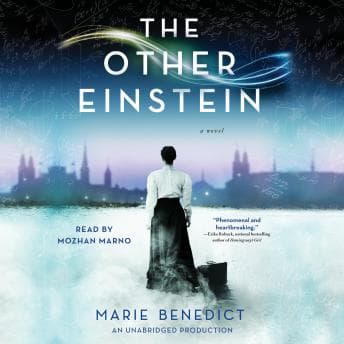
Mozhan Marnò Made Me Feel Uncultured on the Chicago Lakefront
Let's talk about Mozhan Marnò. If you watch The Blacklist, you know her. If you don't, you're about to fall in love with her voice.
I listen to audiobooks because my eyes are usually bleeding from grading 150 essays on The Great Gatsby, so I need a narrator who doesn't just read—they need to soothe. Marnò has this incredible, warm precision. You know how some narrators trip over European names or scientific terms? She treats them like music.
Seriously. She pronounced "Zurich" and "Heidelberg" with this casual elegance that made me feel uncultured just walking my dog along the Chicago lakefront.
I listen at 1.0x speed—yes, I'm that guy, deal with it—and Marnò's pacing is deliberate. She understands that silence is part of the sentence. When Mitza is being dismissed or ignored by Albert (which happens a lot, and it is super frustrating), Marnò drops her voice just a fraction. It breaks your heart way more than a scream would.
A Slow Burn That Sometimes Forgets to Burn
Here's the thing about the story itself—it's a slow burn. Like, really slow.
If you're looking for a thriller or high-stakes drama, this isn't it. It's a quiet, domestic tragedy about intellectual theft. There were moments—usually when I was listening while pretending to organize my bookshelf—where I felt the plot dragging its feet. It's heavy on the internal monologue.
Benedict does this thing where she really wants you to understand the physics and the romance. Sometimes it works. Sometimes it feels a bit like a textbook. But then Marnò pulls you back in with that emotional delivery, and you remember, "Oh right, this is a woman watching her life's work get stolen by her husband."
(My wife Denise listened to about twenty minutes of this with me in the car and got so mad at Einstein she threatened to turn it off. So, effective writing? Yes. Infuriating subject matter? Also yes.)
The Train Wreck You Can't Look Away From
Despite the pacing issues—and yeah, it definitely sags in the middle—I couldn't stop listening. There's something compelling about watching a train wreck in slow motion, especially when you know the train wreck is famous history.
It reminds me of why we read The Yellow Wallpaper in class. It's about being trapped. Red Rising explores a different kind of cage—one built by an entire caste system—but that same suffocating inevitability is there. Mitza is trapped by her gender, by her limp, by her brilliant, selfish husband.
Mozhan Marnò elevates the material. Frankly, I think I would've abandoned the physical book around page 150. But the audio kept me there. It's a performance that gives dignity to a woman who didn't get enough of it in real life.
Who Gets an A, Who Gets a Hall Pass
If you love historical fiction about overlooked women, or you're a sucker for a narrator who can make silence hurt, this one's for you. Skip it if slow-burn domestic drama makes you antsy—there's no thriller pacing here, just quiet devastation.
Class Dismissed
So, is it perfect? No. The pacing requires patience. But is it worth pausing the faculty meeting for? (Hypothetically speaking, Principal Martinez.) Absolutely.