I was shelving returns in the YA section—last hour before close, fluorescent lights buzzing that particular frequency that makes everything feel slightly off—when Chapter 65 hit. I actually stopped moving. Stood there holding a copy of Eragon like some kind of literary scarecrow while the cliffhanger ending ripped through my earbuds. A patron asked if I was okay. I was not okay.
Let me back up.
The Dramatized Adaptation Did What the Novel Couldn't
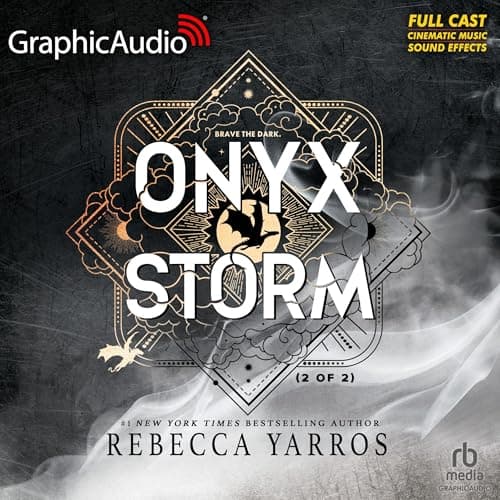
I'll be honest: I came into Onyx Storm with skepticism. Not about Yarros—I've read the Empyrean books, I know what she's doing—but about whether a dramatized adaptation could handle the tonal shifts this series demands. Fantasy romance lives and dies on the tension between intimacy and spectacle, and most full-cast productions fumble one or the other. They nail the battle scenes but make the quiet moments feel like a soap opera, or they get the romance right but the action sounds like a Renaissance faire gone wrong. That same tightrope walk—epic scope without losing the human-scale stakes—is something I kept thinking about when I reviewed Words of Radiance, a book that somehow makes a thousand-page fantasy feel intimate.
This production threads that needle. Khaya Fraites as Violet is the kind of casting that makes you forget there was ever another voice for the character. She sounds young enough, which matters more than people realize—Violet is supposed to be in over her head, and Fraites captures that barely-held-together quality without tipping into whiny. Gabriel Michael's Xaden has this low, controlled intensity that works whether he's being tender or terrifying. The contrast between them carries scenes that, on the page, sometimes felt rushed.
And the sound design. The cinematic score doesn't just sit underneath the dialogue like wallpaper—it swells and pulls back at moments that actually matter. When the wards are failing, you hear it fracture. When dragons speak, there's a weight in the mix that sits in your chest. Whoever handled the audio engineering understood that fantasy needs to feel physically bigger than the room you're sitting in.
Where the Kissing Noises Live (and Why I'm Conflicted)
Okay. The kissing sound effects. I need to talk about them because they're the one production choice that pulled me out of the experience. Look—I'm not squeamish about romance in my fantasy. I've listened to spicier content than this while grocery shopping without flinching. But there's something about foley-artist-generated mouth sounds piped directly into your ears that crosses a line from immersive to uncomfortable. It's the audio equivalent of someone eating with their mouth open. The voice acting in the romantic scenes is strong enough to carry the emotion without the wet sound effects, and I wish the production team had trusted that.
Here's where my librarian brain kicks in, though—the dramatized format actually clarifies story threads that felt muddled in the standard audiobook. When you have distinct actors voicing characters aligned with different gods, you can track political allegiances and betrayals without constantly rewinding. The comedy lands harder because the actors have real timing. One scene—I won't spoil it, but it involves a deeply inappropriate moment during what should be a serious council meeting—had me laughing out loud in a way the text version never managed.
This Understands That Horror Isn't About Gore—It's About Dread
Wait, Jordan, this isn't horror. I hear you. But hear me: the best moments in Onyx Storm operate on dread. The creeping realization that enemies are inside the walls. The slow understanding that Violet's secret could unmake everything she's fighting for. Yarros isn't writing horror, but she's borrowing its best tool—the feeling that something terrible is coming and you can't stop it. The Complete Poppy War Trilogy weaponizes that same dread across its entire arc, and it hit me in a similar place—that sick, slow certainty that the story is not going to let anyone off easy. The full cast amplifies this because you hear the uncertainty in voices, the pauses that a single narrator might smooth over. When trust fractures between characters, you feel it in the space between their lines.
Shirley Jackson walked so... okay, I'm not going to finish that sentence. Yarros is doing her own thing. But she's doing it with an understanding of tension that I respect.
The cliffhanger ending—I keep coming back to it. My podcast listeners are going to love this. It's the kind of gut-punch that makes you physically pull your headphones off and stare at the wall for a minute. The production leans into it perfectly: the score drops, the sound effects cut, and you're left with just a voice and silence. Goosebumps. Real ones.
Who Should Listen (And Who Should Skip)
If you've already listened to Part 1 of this dramatized adaptation, you're buying this anyway and you should. If you read the novel and felt like something was missing—like the pacing was off or the character voices blurred together—this format genuinely fixes that problem. And if you're the kind of listener who wants your fantasy to feel like a movie in your ears, this is one of the better productions I've encountered.
But if you need a complete story arc and can't handle cliffhangers, know what you're walking into. And if dramatized sound effects—especially during intimate scenes—pull you out rather than pull you in, the standard audiobook might be your better bet.
Shelving that copy of Eragon took me another twenty minutes. I just stood there, processing. Shirley (my cat) was unimpressed when I got home and ranted about the ending. I was still shaken. Worth it? Absolutely.