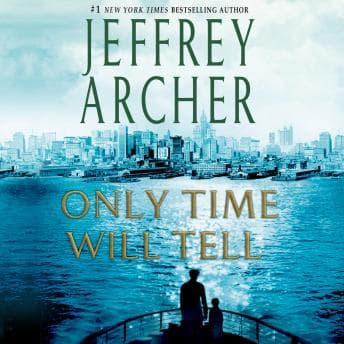

What makes a man who he is - blood or circumstance?
I've been teaching Great Expectations for fifteen years, and every time I get to Pip's discovery about his benefactor, I watch my students' faces shift. That moment when identity cracks open. Jeffrey Archer clearly understands that same narrative power, because Only Time Will Tell grabbed me by the lapels with essentially the same question and refused to let go for nearly thirteen hours.
I started this one grading sophomore essays on symbolism (the irony of grading papers about literature while listening to literature is not lost on me), and somewhere around hour three I realized I'd written "good insight" on six papers in a row without reading a single one. The book had consumed me. Denise found me at midnight, red pen still in hand, completely absorbed in Harry Clifton's Bristol docks.
The Voice in My Head (Two of Them, Actually)
Roger Allam and Emilia Fox. If you're not familiar with British theater and television, just trust me - these are proper actors. Not audiobook-readers-who-took-a-weekend-course. Actors.
Allam does something I rarely hear in audiobook narration: he understands that pause is punctuation. When Harry discovers the truth about his father - and I won't spoil it, but you'll know the moment - Allam lets the silence breathe. My students would call that "dramatic effect." I call it understanding the text.
Fox handles the female perspectives with equal precision. The shifting viewpoints could've been jarring (Archer tells this story from multiple angles, Rashomon-style), but the dual narration actually makes it work better than I imagine the print version does. Each character has a distinct voice. Not caricature - voice. There's a difference, and these two know it.
What Dickens Would Recognize
Here's the thing about Archer that literary snobs (and yes, I've been one) tend to miss: the man can plot. This is old-fashioned storytelling in the best sense. Class struggle. Family secrets. The question of whether we're born into our fate or make it ourselves.
This reminds me of what Hemingway said about Fitzgerald - that he could write a sentence that made you want to read the next one. Archer has that same pull. The prose deserves to be savored, but honestly? I couldn't slow down. I listened at my usual 1.0x (because the author chose those words), but I found myself walking extra laps around the lakefront just to keep listening. That same quality drew me into Selected Short Stories by F. Scott Fitzgerald, where every sentence earns its place.
The Bristol docks in the 1920s. The rigid class structures of pre-war England. Oxford versus the navy. These aren't just settings - they're characters themselves. Archer knows his history, and more importantly, he knows how to make history feel immediate. My students would hate this. I love it.
The Slow Burn That Pays Off
I'll be honest - the first hour requires patience. Archer is laying groundwork. Building a world. If you need explosions in chapter one, this isn't your book. But if you loved Downton Abbey or Upstairs, Downstairs (and if you're under 40, ask your parents), this is their spiritual successor in audiobook form.
The pacing picks up considerably once Harry reaches school. From there, it's a steady escalation toward revelations that genuinely surprised me. And I've been reading fiction for forty-plus years. I've seen most tricks.
One thing worth noting: this is book one of the Clifton Chronicles. It ends on what can only be described as a proper cliffhanger. I immediately downloaded book two. At midnight. On a school night. (Principal Martinez, if you're reading this, I was definitely well-rested for the faculty meeting the next morning. I wasn't. I was thinking about Harry Clifton.)
Who This Is For (And Who Should Skip It)
If you loved the classics - Dickens, Galsworthy, even Trollope - and you want something with that same sweep but modern pacing, this is it. If you're a historical fiction enthusiast who appreciates research that doesn't feel like research, this is it. If you've got a long commute and want something that'll make you sit in the parking lot for "just five more minutes," this is definitely it. But if slow-building family sagas test your patience, or you need action in the first chapter, look elsewhere.
Mr. Williams Assigns His Homework
Look, I came to audiobooks late. Spent years thinking they were somehow lesser. Now I've got nearly thirteen hours of Jeffrey Archer in my ears and I'm ready to admit: some stories are meant to be heard. The dual narration here isn't a gimmick - it's an enhancement. Allam and Fox understand that great narration is performance art.
Is it literary fiction in the capital-L sense? No. It's not trying to be. It's a family saga, a historical epic, a page-turner that happens to be exceptionally well-crafted. The kind of book that reminds you why people have been telling stories since we lived in caves.
I've got 47 podcast listeners who trust my literary judgment. Make that 48 if you count Denise (she falls asleep during my Faulkner episodes, but she stayed awake for my rant about this book). Consider this my recommendation.
Now if you'll excuse me, I have book two queued up and a stack of ungraded essays that can wait until tomorrow.