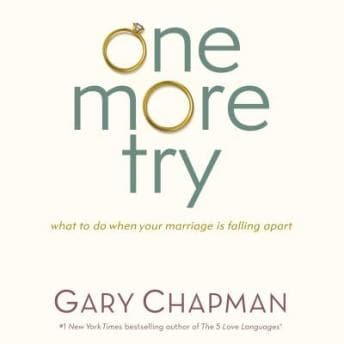

"Anger is not a sin. But it is an emotion that, if not handled wisely, can lead to sinful behavior." I was chopping onions for chana masala when that line hit me through my kitchen speaker, and I actually stopped mid-chop. Not because it's groundbreaking psychology — any intro psych student knows the difference between emotion and behavior — but because Chapman drops it so plainly, so pastorally, that it lands differently than reading it in a textbook. And that's both the strength and the limitation of One More Try.
When the Counselor's Office Has a Pulpit
Let me be honest about what this book is. Gary Chapman has 30+ years of marriage counseling experience and a background in anthropology and theology, and both of those disciplines show up here in roughly equal measure. This is not a secular psychology text. It's a faith-based framework for saving a marriage, rooted in biblical principles with practical steps layered on top. If you're coming in expecting something like Gottman's research-driven approach to marital repair, you will be disappointed. One listener nailed it when they said it felt "similar to a sermon" — and yeah, that's accurate. But here's the thing: for people who want that framework, who process their pain through faith, Chapman speaks their language fluently.
What I found myself asking: why does Chapman structure the book the way he does? He starts with the crisis moment — being blindsided — and then moves through anger management, loneliness, and rebuilding trust. Psychologically, that progression tracks. It mirrors stages of grief, actually: shock, rage, isolation, tentative hope. Whether Chapman mapped that intentionally or it emerged from decades of sitting across from hurting couples, the architecture is sound. The research actually shows that addressing emotional dysregulation before attempting reconciliation work is critical, and Chapman gets that sequencing right even if he frames it through Scripture rather than clinical literature.
But — and this is where it gets complicated — the advice stays general. Chapman discusses categories of marital failure rather than getting granular. He'll tell you anger is natural but needs healthy expression, which, yes, true. But how? The specific techniques feel thin. It's the difference between a therapist saying "you need to communicate better" and actually teaching you what that sounds like sentence by sentence. My therapist would have thoughts about this gap.
Jon Gauger and the Art of Hopeful Steadiness
At 3 hours and 26 minutes, this is a quick listen — I got through most of it during one cooking session and the tail end on my morning jog the next day. Jon Gauger's narration is... steady. Clear. Warm without being saccharine. He reads Chapman's words with the tone of a kind pastor delivering Sunday's message, which is perfectly calibrated for the content. There's no vocal fireworks here, no dramatic range needed — this is a single-voice, straightforward self-help narration, and Gauger doesn't try to make it something it's not.
That said, the production is bare bones. No music, no sound design, no supplementary elements. Just Gauger's voice and Chapman's words. For a book aimed at people in genuine marital crisis — people who are probably distracted, emotionally raw, maybe listening in their car after a terrible argument — I wonder if a slightly warmer production might have served the material better. But clean audio is clean audio, and I'd rather have that than distracting bells and whistles.
The Psychological Honesty Problem
Here's where the researcher in me gets restless. Chapman acknowledges that some marriages involve abuse, addiction, and infidelity — serious, clinical-level problems. And he does, to his credit, distinguish between situations where reconciliation is possible and where safety must come first. But the book's fundamental thesis — that most marriages are worth one more try — carries an implicit optimism that doesn't always account for the psychology of trauma bonding or the documented patterns of narcissistic abuse cycles. The protagonist of this book (and yes, the reader is the protagonist in self-help) exhibits classic hope bias: the belief that effort will be reciprocated. Chapman encourages that belief. Sometimes that's healing. Sometimes it's dangerous.
This is a fascinating case study in how faith-based counseling and evidence-based psychology overlap and diverge. The tension between self-belief frameworks and actual psychological mechanics is something I kept bumping into in Game of Life and How to Play It too — good intentions dressed up as practical tools, with the seams showing if you look closely enough. Chapman's instincts about empathy, patience, and emotional regulation are psychologically valid. His framework for when those instincts should override the impulse to leave? That's where personal worldview — not research data — takes the wheel.
Who Gets Something Real From This
If you're a person of faith navigating a marriage in serious trouble, and you want encouragement grounded in biblical principles with a gentle, experienced voice guiding you through it — this will meet you where you are. If you're looking for research-backed therapeutic strategies with specific exercises and measurable outcomes, this isn't your book. Both of those things are okay.
I wouldn't spend a full credit on a 3.5-hour listen that stays at this altitude of generality, but it's a solid resource for someone who needs to hear "you're not alone in this" from someone who sounds like they mean it.
My Clinical Notes, Off the Record
Chapman knows people. He's sat with enough broken marriages to understand the emotional landscape. Gauger delivers that understanding with quiet competence. But knowing people and giving them actionable tools are different skills, and this book leans heavily toward the former. Worth your time if you know what you're getting. Just manage your expectations about what "practical steps" means here — it's more compass than roadmap.