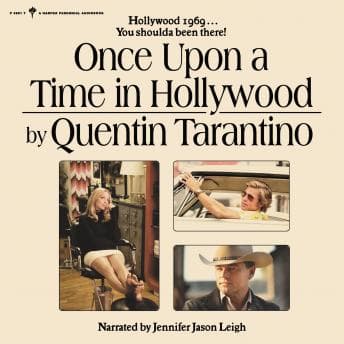

Quentin Tarantino wrote a novel, and it is exactly as indulgent, digressive, and weirdly magnetic as you'd expect from the guy who made a World War II movie where the climax is burning down a cinema.
I finished this one at like 2 AM on a Tuesday, sitting cross-legged on my apartment floor surrounded by a half-assembled game of Gloomhaven that I'd abandoned around hour three of the audiobook because I couldn't stop listening. Which is weird, because this book should not work as well as it does. It's basically Tarantino doing what Tarantino does in movies — long conversations about pop culture, loving recreations of a specific era, characters who talk way too much about stuff that doesn't matter until suddenly it matters a lot — except now it's prose. And it's 12 hours and 43 minutes of it.
Tarantino's World-Building Is Not Sanderson's, But It's Something
Look, I know this isn't my usual lane. No magic systems here. No progression fantasy. But I have to give credit where it's due: the way Tarantino builds 1969 Hollywood is genuinely impressive world-building, just of a different kind. He's not constructing allomancy tables — he's reconstructing an entire ecosystem of TV westerns, Italian genre cinema, and the specific hierarchy of who gets to eat at Musso & Frank's versus who's stuck at the bar. Rick Dalton's career trajectory through the declining western TV landscape is rendered with the kind of obsessive detail that reminds me of how Sanderson handles Roshar's ecology. Except instead of cremlings, it's pilot season politics.
The novel expands significantly on the film. Cliff Booth's backstory gets way more room to breathe, and Tarantino digs into the Manson Family stuff with a historian's fixation that the movie only hinted at. There are entire chapters that feel like essays about spaghetti westerns and the transition from old Hollywood to new Hollywood. If you don't like info-dumps, this isn't for you (but you're wrong). I had the opposite problem with Into the Water, where the digressions felt like they were actively running away from the story instead of enriching it. Tarantino is writing love letters to a dead industry, and those digressions ARE the point.
Jennifer Jason Leigh: The Polarizing Dungeon Master
Okay. So. The narration.
Here's the thing — Jennifer Jason Leigh is a fantastic actress, and you can hear her intelligence in every line reading. She gets Tarantino's rhythms. The comedic beats land. When she's narrating the omniscient Tarantino voice — that loose, conversational, slightly smug authorial tone — she's actually pretty great. There's a vocal fry thing happening that works for the laid-back 1969 vibe.
But when she has to differentiate between Rick Dalton, Cliff Booth, and Charles Manson? It gets rough. The voice modulation is so subtle that I kept losing track of who was talking during dialogue-heavy sections. Cliff and Rick in particular blurred together for me, and in a book where their dynamic IS the emotional core, that's a real problem. It's like having a DM who does a great narrator voice but whose NPC voices all sound like the same guy with slightly different posture.
I can absolutely see why some people bounced off the narration entirely. The pacing is deliberate — Leigh reads this like a literary novel, not like a thriller — and combined with Tarantino's already digressive style, there are stretches where your attention just drifts. I had to rewind multiple times during the long film-industry history sections because I'd zone out.
That said, the people calling her narration "zero-emotion" are wrong. There are genuinely funny moments where her delivery is perfect, and the poignant beats — especially around Sharon Tate — hit harder than I expected.
Who Rolls Initiative on This One
This is for a very specific listener. You need to care about — or at least be curious about — late '60s Hollywood. You need to be okay with a book that would rather spend 20 minutes on the history of Italian westerns than advance its plot. You need to either like or tolerate Jennifer Jason Leigh's voice for nearly 13 hours.
If you loved the movie, this is a fascinating companion piece. If you've never seen the movie, honestly? You might still enjoy this, but you'll be confused by the tonal shift in the final act.
My D&D group would… actually not love this one. Not enough swords. But the one guy in my group who's a film school dropout would lose his mind over it.
I read this instead of writing my thesis, and I don't regret it, but I also don't think I'd listen again. It's a 13-hour Tarantino director's commentary disguised as a novel, and that's either exactly what you want or your personal hell.
Roll Credits, Grab a Whiskey Sour
Solid book, imperfect audiobook. Tarantino can actually write prose — who knew? — but the narration holds this version back from greatness. If you're a Tarantino completist, grab it on sale. If you're the kind of person who reads the appendices in Lord of the Rings, you'll probably dig the obsessive detail. And if you want that same obsessive detail applied to a fantasy world with actual swords and court intrigue, Court of Wings and Ruin scratches a surprisingly similar itch — dense lore, political maneuvering, the works. Everyone else: maybe just rewatch the movie.









