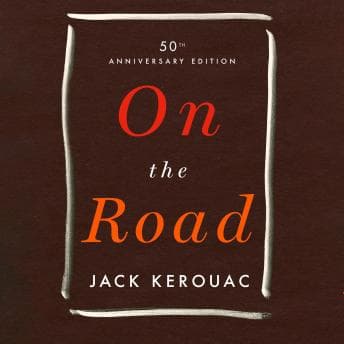

People talk about On the Road like it's this wild, liberating manifesto of freedom. And it is. But here's what nobody prepared me for: listening to David Carradine read it at 11 PM while grading junior essays on The Great Gatsby made me feel like I was betraying both books simultaneously. Gatsby's careful construction, Kerouac's deliberate chaos—and me in the middle, red pen in hand, wondering when I stopped believing in spontaneous prose.
This is an abridged version. Two hours and thirty-six minutes. I need to say that upfront because some of you will consider that heresy, and honestly? You might be right.
The Ghost of Kung Fu in Your Ears
Let's address the elephant: David Carradine. If you're of a certain age—my age, the age where your knees predict weather—you cannot unhear Kwai Chang Caine. That deliberate, almost meditative cadence he perfected in Kung Fu bleeds into everything. Some listeners found this maddening. I found it... unexpectedly appropriate?
Kerouac's prose is jazz. Everyone says this. What they don't say is that Carradine reads it like a man who's been on his own road, who's seen the same American highways and felt the same restless ache. There's a weariness in his delivery that shouldn't work but does. By the time he reaches those final lines—the ones about Dean Moriarty, about the evening star—I understood why people reported crying. I didn't cry. (I was grading. Denise was asleep. The lakefront was dark outside our window.) But something caught in my throat.
Carradine understands that pause is punctuation. He takes his time. This will frustrate listeners who want momentum. But Kerouac chose those words, and Carradine chooses to let them breathe.
Two Hours Is Not Enough Road
Here's my problem, and it's a significant one: this abridgment cuts the novel down to a sprint when the whole point is the marathon. On the Road isn't about arriving anywhere. It's about the going. The repetition. The way Sal keeps chasing Dean across the country like he's chasing something that can't be caught.
You lose that in two and a half hours. You get the highlights reel instead of the journey. It's like showing someone a slideshow of a cross-country drive and calling it the same experience. My students would hate this comparison. I love it.
If you've never read Kerouac, this abridgment might actually work as an introduction—a taste, a sampler, enough to decide if you want the full experience. But if you're coming to this as a devotee, you'll feel the absences. The digressions that aren't here. The parties that got cut. The long stretches of nothing-happening that somehow meant everything.
Worth Pausing the Faculty Meeting For?
This reminds me of what Hemingway said about writing—you have to know what to leave out. The problem is, Kerouac's genius was in what he left IN. The spontaneous prose, the run-on sentences, the breathless accumulation of American geography. An abridged On the Road is almost a contradiction in terms.
And yet. And yet.
Carradine's emotional delivery in those final moments earns something. There's genuine feeling there, not performance. When he reads about thinking of Dean Moriarty, about the whole raw land rolling in one unbelievable huge bulge to the West Coast—you believe he's been there. You believe he understands.
Content warnings for the uninitiated: language, sex, drugs, alcohol, and the kind of casual misogyny that was invisible in 1957 and is very visible now. I teach this book. I have to have conversations about it. The women exist as scenery. It's a limitation of its era that doesn't diminish the prose but can't be ignored either.
I had the same uneasy reckoning with Oliver Twist—a book I love and teach and still have to hold at arm's length sometimes for what it does with its women and its villains.Who Gets on This Bus (And Who Should Hitchhike Past)
This version is for: curious newcomers who want a taste before committing; nostalgic Carradine fans who want to hear that voice one more time; commuters who need something short and literary; teachers like me who want a refresher without the full investment.
Skip it if: you're a Kerouac purist; you've never read the book and deserve the complete experience; or you consider abridgment a moral failing. (I see you, and I respect you, and I slightly agree with you.)
Mr. Williams's Final Grade
I listened to this three times. Once while grading. Once while walking the lakefront at dawn. Once while pretending to pay attention to Principal Martinez's quarterly review. (Sorry, Principal Martinez. I was in Denver with Dean Moriarty.)
It's not the definitive On the Road experience. It can't be. But there's something in Carradine's reading that captures the melancholy underneath Kerouac's manic energy—the sadness that Sal never quite admits to, the knowledge that the road ends somewhere, eventually, for everyone.
The prose deserves to be savored. Even in abbreviated form. Even at 1.0x speed. Even when you should be grading papers instead.