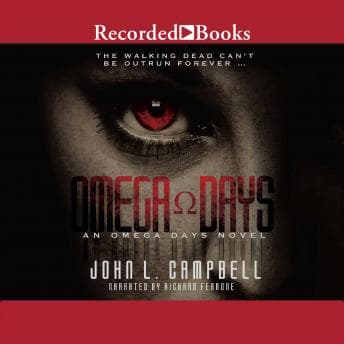
Look, I'll be honest - when I see "zombie apocalypse in San Francisco" and "escaped inmates" in the same blurb, my expectations calibrate to a very specific place. Popcorn horror. Competent but disposable. The kind of thing you half-listen to while doing dishes and forget by Thursday.
I was mostly right. But not entirely.
The Dead Walk and So Does the Ensemble
Omega Days does something that a lot of zombie fiction fumbles: it commits to the ensemble. Campbell doesn't give you one hero and a bunch of cannon fodder. You get a priest dragging around guilt like a second skin, a college student who picks up a rifle and discovers she's unnervingly good with it, inmates from San Quentin who are suddenly the least dangerous things in the Bay Area. The rotating POV structure means you're constantly jumping between survivor pockets as San Francisco collapses, and it works - mostly because Campbell understands that zombie stories live or die on the humans, not the zombies.
The priest, in particular, got under my skin. There's a scene early on where he's moving through a church that's become a slaughterhouse, and the way he processes what he's seeing through the lens of his faith - not in a preachy way, but in this broken, desperate bargaining - felt genuinely raw. As someone who grew up in a household where religion was wielded like a shield against anything dark or messy, watching a character use faith as a crumbling scaffold while the world ends? That hit different.
The sniper arc is fun but less surprising. College girl discovers inner badass during apocalypse - we've seen it. Campbell writes her competently, gives her enough personality that she's not just a skills checklist, but I've read this character before in a dozen other series.
Richard Ferrone Knows What He's Doing
Here's where my expectations got properly exceeded. Ferrone's voice is built for this kind of material - low, steady, with this gravel that makes everything feel like it's being reported from the edge of catastrophe. But what impressed me is the restraint. He doesn't go full carnival barker during the action sequences. When zombies swarm a barricade, his pacing tightens but his tone stays controlled, almost clinical, and that contrast between what's happening and how it's being delivered creates more tension than screaming ever could.
The narrator commits. That's rare.
His differentiation between the ensemble cast is solid - not showy, but functional. The priest gets a measured, slightly hollow quality. The inmates sound rougher, faster. It's not voice acting in the theatrical sense, but it's clear and consistent across twelve-plus hours, which is harder than it sounds.
Where the Rot Sets In (and I Don't Mean the Zombies)
Here's the thing - Omega Days is Book One, and it feels like Book One. Campbell is setting up so many pieces that some of them just... sit there. A few POV characters get introduced with just enough detail to signal "I'll matter later" and then vanish for long stretches. The pacing is genuinely fast for the first six hours, but there's a section around hour eight where the momentum stalls as we're establishing yet another group of survivors in yet another location, and I found myself reaching for the speed controls.
And the zombies themselves? They're zombies. They shamble, they bite, they swarm. Campbell doesn't reinvent the rules or add any mythology that would distinguish these dead from the Romero standard. If you're looking for horror that pushes the genre somewhere new, this isn't it. This is comfort-food apocalypse fiction - well-executed, satisfying, but not surprising. White Cargo gave me that same feeling - genre machinery running clean, no apologies for being exactly what it is.
I listened to this shelving returns at the library on a Tuesday afternoon, earbuds in, wheeling my cart through the stacks. The fluorescent lighting and mundane routine made a surprisingly good contrast with San Francisco burning. Though I'll say - Shirley (my cat) was unimpressed when I brought the energy home and tried to explain why I was invested in fictional prison escapees. She had a point.
Who Needs This in Their Queue
If you burn through zombie fiction the way I burn through Shirley Jackson essays - compulsively, with genuine love for the form even when individual entries don't break new ground - you'll enjoy this. It's propulsive, it's competently structured, and Ferrone's narration elevates the material beyond where it might land on the page.
If you scare easily, skip. If you don't, you need this - with the caveat that "need" here means "will enjoy solidly" not "will have your worldview rearranged."
Skip if: you're burned out on zombie fiction and need something to justify returning to the subgenre. This won't convert you.
Grab it if: you want a twelve-hour apocalypse sprint with a narrator who knows how to make gunshots feel loud without raising his voice.
Shelved Under: Reliable, Not Revolutionary
My podcast listeners are going to get a segment on this - not because it reinvents anything, but because it's a clean example of ensemble zombie fiction done right. Campbell clearly loves the genre, and that love shows in the structural choices even when the individual beats feel familiar. Ferrone's the real MVP here, turning what could've been background noise into something worth your focused attention.
Finally, horror that respects the genre. Even if it doesn't push it forward.