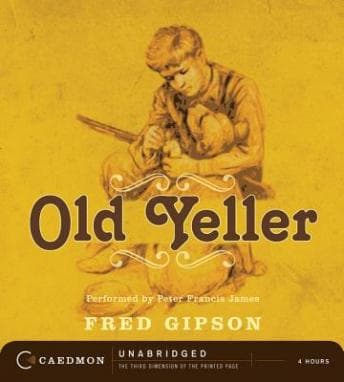

Look, I wasn't planning to cry on the Caltrain at 7:15 AM on a Tuesday. That wasn't the agenda. The agenda was: finish debugging that memory leak in my head, zone out to something light before the Mountain View chaos begins. But here I am, a grown woman with a CS degree, trying to pretend my eyes are watering because of allergies while Peter Francis James describes a boy saying goodbye to his dog in 1860s Texas.
Old Yeller got me. It just... got me.
Why This Works at 6 AM (And Why That's Saying Something)
Quick Verdict: This is a 3.5-hour gut punch disguised as a children's classic. Perfect commute length—I finished it in exactly two round trips.
Here's the thing about audiobooks on packed trains: they need to hold your attention through crying babies, that guy who always takes speakerphone calls, and your own pre-caffeine brain fog. Old Yeller does this by being deceptively simple. Fred Gipson's prose is clean—no elaborate metaphors, no showing off. Just a 14-year-old kid named Travis, a stray yellow dog, and the Texas frontier trying to kill them both in various creative ways.
The pacing is slower than what I usually go for (I'm a thriller person, sue me), but it works. It's not slow like "could've been a blog post" slow. It's slow like watching a campfire burn down—you're not bored, you're just... present. I actually listened at 1.25x instead of my usual 1.5x because speeding through this felt wrong somehow.
Peter Francis James Nails the Texas Twang
Okay, narrator breakdown. Peter Francis James does something I really appreciate: he commits to the accent without making it a caricature. His Travis sounds like an actual kid from the Texas hill country, not a cartoon cowboy. There's this warmth in his voice that makes you trust him immediately—which matters, because this story earns its emotional weight through quiet moments, not dramatic ones.
The character voices are distinct without being distracting. Travis's little brother Arliss (who is, frankly, a menace) sounds appropriately chaotic. The mom sounds tired in that specific frontier-widow way. And Old Yeller himself—well, the dog doesn't talk, obviously, but James describes his actions with this affection that makes you see exactly what kind of dog he is. Loyal. Brave. Dumb in that beautiful way dogs are dumb.
One listener quote I found said James's narration was "mesmerizing," and yeah, I'd agree. It's not showy narration. It's the kind where you forget someone's reading to you.
The Emotional Payload (You Know What's Coming)
I'm not going to spoil it for the three people who don't know how this ends, but—you know. You know what happens. I knew what was coming and it still wrecked me.
What surprised me is how much the book earns that ending. It's not manipulation. It's not cheap. Travis grows up over the course of this story in ways that feel real—he starts out resentful and ends up... different. Harder, but not broken. The frontier violence is real (content warning: animals get hurt, some die, it's not sanitized), and Gipson doesn't pretend life was easy out there.
This is basically The Yearling but for dog people. Same energy: coming-of-age, harsh lessons about nature and responsibility, the specific grief of loving something you can't protect. Their Eyes Were Watching God has that same quality—beautiful prose about hard truths, the kind of story that sits with you long after you finish.
Who This Is (and Isn't) For
Perfect for: commutes under an hour, family road trips (though maybe prep the kids for the ending), anyone who needs a good cry but in a cathartic way.
Skip if: you're emotionally fragile right now, or you genuinely cannot handle animal death in stories. I'm not judging—I have friends who can't do it. This book will hurt them.
The production quality is clean, no weird audio issues. At 3.5 hours, the ROI is solid—you get a complete, satisfying story without the commitment of a 15-hour epic.
Cached in Long-Term Memory
Would I listen again? Probably not soon. Not because it's bad—because it's good in a way that stays with you. I don't need to revisit it. It's already in there, somewhere between my distributed systems knowledge and my irrational attachment to Ray Porter's voice.
But I'm glad I finally listened. Sometimes the classics are classics for a reason. And sometimes you just need to cry on public transit and let the commuters around you wonder what happened.