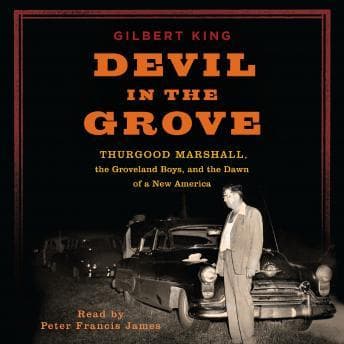

Let me tell you what's wrong with this book. It made me late for a client meeting. Twice.
I started Devil in the Grove on a drive back from a corporate security assessment in San Antonio - standard two-hour windshield time, figured I'd knock out the first few chapters. By the time I pulled into my driveway in Austin, I sat in the truck for another forty minutes because Gilbert King had just laid out how Sheriff Willis McCall ran Lake County, Florida, like his personal fiefdom, and I couldn't walk away from it. Ranger was staring at me through the front window like I'd lost my mind.
The Sheriff Who Thought He Was God
Let me cut to the chase: this book is about institutional evil wearing a badge. And I don't use that word lightly. I've operated in environments where the rule of law was a suggestion at best - Fallujah, Kandahar - but what King documents in 1949 Lake County hits different because it's home soil. Willis McCall wasn't some warlord in a failed state. He was a duly elected American sheriff who shot two handcuffed prisoners he was transporting, then claimed self-defense. Handcuffed. In his custody. I've seen this scenario play out in real life overseas, and we called it what it was - a war crime. Here it was just Tuesday in central Florida.
King built this book from FBI files that had never been unredacted before, plus the NAACP Legal Defense Fund's own records. The author clearly did their homework - and then some. You can feel the weight of primary sources on every page. He doesn't editorialize much. He doesn't need to. The facts are damning enough. The citrus barons using Jim Crow labor, the Klan functioning as an unofficial arm of law enforcement, the entire machinery of a county designed to keep Black men picking oranges and never looking up - King lays it all out with the precision of an after-action report.
And then there's Thurgood Marshall. This isn't the marble-statue version you learned about in school. This is a man who drove through Florida at night knowing the Klan had a bounty on his head, who kept taking impossible cases because nobody else would, who was juggling the Groveland Boys defense while simultaneously building the legal foundation for Brown v. Board. The man was running two wars at once, and one of them could've gotten him killed any given night.
Peter Francis James Knows What Restraint Can Do
Here's what works about the narration: James doesn't try to make you feel anything. His tone stays even, almost clinical at points, and that restraint is exactly what this material needs. When he reads the descriptions of what happened to the Groveland Boys - the beatings, the railroaded trial, McCall's cold-blooded shooting - that steady voice makes the horror land harder. It's the difference between someone screaming about an atrocity and someone calmly reading the incident report. The report is worse.
He shifts into a more colloquial register for direct quotations, which helps you hear the actual voices of the people involved without turning it into a performance piece. Smart choice for an 18-hour listen. No vocal gymnastics, no dramatic pauses fishing for your emotions. Just clean, controlled delivery that trusts the material. I ran it at 1.25x and it held up perfectly - James's pacing is deliberate enough that the speed bump actually helped the momentum without losing clarity.
Where It Tests Your Patience (And Why That's the Point)
This is where it lost me - briefly. Around the middle stretch, King digs deep into the legal maneuvering and the internal NAACP politics, and there are sections that feel like you're reading case briefs. Which, honestly, you kind of are. It's dense. I won't pretend I didn't zone out once during a long procedural passage and have to rewind. But here's the thing - that density is earned. King is showing you how the system was rigged at every level, and you need to see the gears to understand the machine. It's not a flaw so much as a demand on your attention.
At nearly 18 hours, this is a commitment. Think of it as a deployment, not a day trip. But I never considered abandoning it. The same thing happened to me with Boys in the Boat - another long haul that kept ratcheting up the stakes until abandoning it felt genuinely unthinkable. The Groveland case keeps escalating in ways that would feel implausible in fiction - a bombing, a shooting by the sheriff himself, Supreme Court involvement, a second trial that's somehow worse than the first. Every time you think the system can't fail these men more completely, it does.
Who Needs to Hear This
Anyone who thinks they understand American history but has never heard of the Groveland Boys. Anyone who works in law enforcement or security (like me) who needs the reminder of what happens when authority operates without accountability. If you only read military history or thrillers - branch out for this one. It reads like a thriller anyway, except nobody had to make anything up, and that's the worst part.
Skip it if you want background listening for the gym. This demands your full attention and frankly deserves it.
Ranger and I Are Still Thinking About This One
I finished the last chapter parked outside a client site, ten minutes early for once. Sat there with the engine off. Ranger wasn't with me for that one, but Linda was, and she didn't say anything either. Some books you finish and immediately rate. This one you sit with. The Groveland Boys were posthumously exonerated in 2019 - seventy years after their lives were destroyed. Gilbert King helped make that happen. Worth your time? Here's the debrief: this is one of the most important pieces of American history you'll listen to this year. Mission accomplished, and then some.







![Steve Jobs [unabridged audiobook] audiobook cover](/_next/image?url=https%3A%2F%2Fcovers.audiobooks.com%2Fimages%2Fcovers%2Ffull%2F9788499923406.jpg&w=1920&q=75)