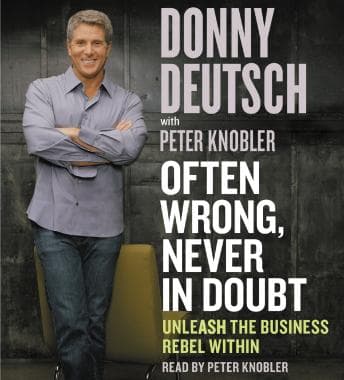

Donny Deutsch is the kind of guy my therapist would have a field day with.
I was chopping onions for a chana masala at 9 PM on a Tuesday — the kind of elaborate cooking-for-one situation I'm not apologizing for — when Deutsch started talking about walking into his father's advertising agency with zero experience and basically willing himself into running the place. And I found myself asking: why does this man's complete lack of self-doubt not annoy me more?
Because it should. The title tells you everything. "Often Wrong, Never in Doubt" is practically a clinical description of overconfidence bias, and as someone who studies why people construct the narratives they do, I should be picking this apart like a bad character study. But here's the thing — Deutsch knows exactly what he is. He's not pretending to be a humble visionary. He's telling you, flat out, that conviction matters more than correctness, and he's got the receipts from building Deutsch Inc. into one of the biggest advertising agencies in the country.
The Psychology of Shameless Confidence
The protagonist — because that's what Deutsch is in his own story — exhibits classic narcissistic entrepreneurial energy, but with a twist I didn't expect. He's genuinely self-aware about it. There are moments where he talks about his high school years in New York, the insecurities underneath the bravado, and you can hear the kid behind the mogul. One listener mentioned being surprised at how similar their own adolescent experience was to Deutsch's, and I get that. He doesn't sanitize his youth into some rags-to-riches myth. He was a middle-class kid from Queens who was terrified and compensated by being the loudest person in every room.
The research actually shows that this kind of compensatory confidence — the fake-it-til-you-make-it school — works disproportionately well in sales and media environments. Deutsch basically built a career proving that. But what makes this book more than just "cocky guy brags for five hours" is that he structures his stories as lessons, and they're surprisingly specific. He doesn't just say "take risks." He tells you about pitching IKEA when his agency had no business being in the room, about the Clinton/Gore communications work, about the exact moments where his instinct was wrong but his commitment to the bit carried him through.
Psychologically, this tracks. People don't succeed because they're always right. They succeed because they act while everyone else is still deliberating. I've heard sales trainers hammer this same point home in Close That Sale!: The 24 Best Sales Closing Techniques Ever Discovered, though Deutsch's version comes with way better bar stories. It's not a new idea, but Deutsch makes it visceral rather than theoretical.
Peter Knobler's Manhattan Energy
Here's the interesting production choice — the narrator is Peter Knobler, who co-wrote the book. Not Deutsch himself. And honestly? It works better than it should. Knobler reads with this Manhattan accent that gives the whole thing a conversational, slightly sardonic quality. It sounds like a guy telling you war stories at a bar in Midtown, not like a polished audiobook performance. The delivery is motivating without being one of those "YOU CAN DO IT" self-help voices that make me want to throw my headphones into the Charles River.
At five hours and change, it's a quick listen — I got through it across two cooking sessions and a morning jog through Cambridge. The brevity is actually a strength. Deutsch doesn't overstay his welcome. He tells his stories, drops his lessons, and gets out. No padding, no repetitive chapter summaries, no "let me tell you what I just told you" nonsense.
The weakness — and I'll be honest here — is that the book is very much a product of its era. Deutsch's world is pre-social media advertising, pre-streaming, pre-everything that defines business now. The principles are evergreen enough (confidence, hustle, reading people), but some of the specific anecdotes feel like dispatches from another century. If you're looking for tactical advice about building a business in 2024, this isn't it.
Who This Is Really For (And Who Should Walk Away)
If you're someone who needs permission to be bold — to pitch the thing, ask for the raise, start the company — Deutsch is basically handing you a psychological permission slip for five hours straight. It's motivational without being saccharine, practical without being a textbook.
But if you're allergic to ego, if you need humility from your business authors, if you want data-driven frameworks — skip this. Deutsch doesn't cite studies. He cites himself. Repeatedly.
I found it genuinely entertaining. Not life-changing, not paradigm-shifting, but a solid listen that made me think about how the stories we tell ourselves about our own competence literally shape our outcomes. Which is, you know, my entire research area. So I'm biased.
My Diagnosis
This is a fascinating case study in how self-narrative creates reality. Deutsch believed he was the guy, so he became the guy. Is that replicable? Maybe not. Is it fun to listen to? Pretty much, yeah. For a deeper dive into how belief literally reshapes reality, Essence of Self-Realization: The Wisdom of Paramhansa Yogananda explores the same territory from a spiritual angle—though it won't make you want to pitch IKEA. My one real complaint is that at this length and with content that's more inspirational than instructional, it's hard to justify a full credit. Catch it on sale or stream it. You'll finish it before your dal is done simmering.